


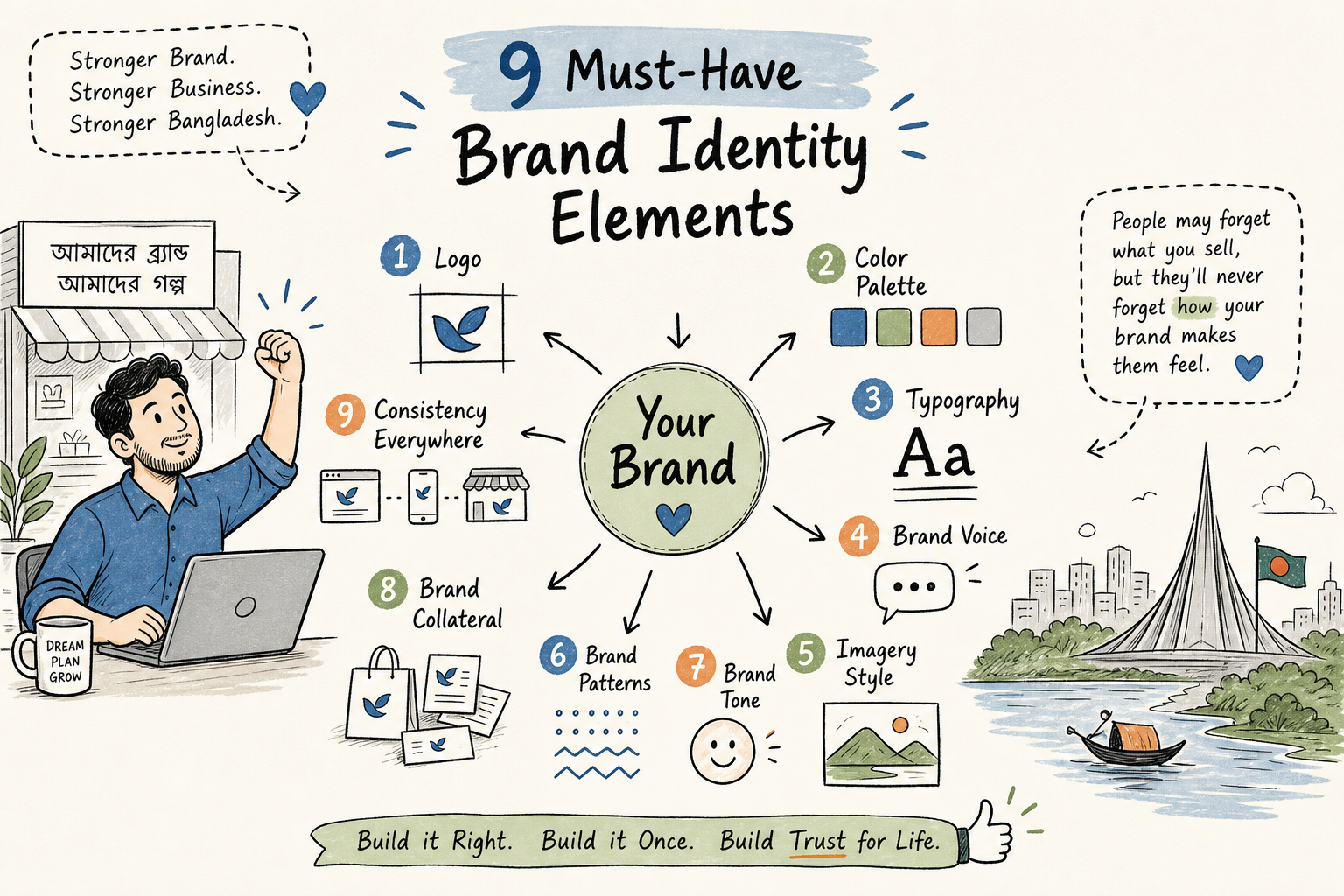
Learn essential brand identity elements for Bangladeshi businesses. Levree explains how to build a strong and memorable brand.
What makes a strong brand identity for a Bangladeshi business? It starts long before a logo gets designed or a color palette gets chosen, and most SMEs skip straight past it. The typical pattern: money goes into ads before anyone has fixed the thing that makes ads actually work. The result is predictable. Ad spend climbs, cost-per-click rises, and conversions stay flat because visitors land on a brand that doesn't feel trustworthy enough to buy from.
Consumer behaviour data from Bangladesh confirms what any experienced marketer already suspects. Price is the primary purchase driver for 47% of Bangladeshi shoppers, but the moment price becomes competitive, brand becomes the tiebreaker. Once buyers find two or three options at roughly the same price point, they default to whichever brand feels more credible and familiar. Businesses that haven't built brand equity have nothing left to close with except a lower price. That's a race with no finish line.
The nine elements covered in this article aren't a checklist. They're an interconnected system, and each one affects how well the others perform. At Levree, our Dhaka-based branding and digital marketing agency, we build full-stack brand identity systems for Bangladeshi SMEs across healthcare, e-commerce, and professional services. We've seen firsthand which elements move the needle and which ones businesses keep skipping. This article gives you the full framework plus a practical 30-day audit at the end, so you leave with three concrete moves, not just theory.
Why brand identity hits differently in Bangladesh
The price-trust paradox Bangladeshi buyers live in
The 47% price-sensitivity figure tells one story. The rest of the data tells another. Once buyers find comparable options on Facebook Commerce or Daraz, which is common across most product categories, the final decision comes down to which brand feels more credible. That's the trust gap. SMEs that cut prices to win short-term erode the brand equity they need to win long-term. The goal isn't to out-cheap competitors. It's to out-trust them.
What local brands like Aarong figured out early
Aarong didn't succeed by offering the lowest price on clothing. It built an identity around Bangladeshi craft, rural artisan heritage, and cultural pride, giving the brand a meaning that no competitor could copy by simply cutting margins. Zurhem took a different route, filling the luxury menswear gap with a clear position rooted in couture craftsmanship and heritage fusion. Le Reve built consistent recognition through style positioning and a modern retail experience. None of these brands succeeded by cloning global templates. They rooted their identity in a specific cultural truth and held it consistently. That principle applies whether you're running a Dhaka clinic, a Chittagong spice brand, or an online fashion label.
What makes a strong brand identity for a Bangladeshi business: the strategic foundation
1. Purpose: starting with why your brand exists
Purpose is the base layer of brand identity , and it's the most commonly skipped. A Bangladeshi food brand, medical clinic, or fashion label needs a clear answer to one question: why does this business exist beyond generating revenue? Not a corporate-sounding mission statement, a single sentence the founder can say with conviction. A clinic that exists to make specialist healthcare accessible in underserved areas of Dhaka will make fundamentally different brand decisions than one built to be the most premium practice in Gulshan. Purpose shapes everything downstream, from tone of voice to color choice to how customer service DMs get written.
2. Positioning: claiming a distinct space in the market
Positioning is the specific space your brand occupies in a buyer's mind relative to every alternative they're aware of. Think about a skincare brand competing in Bangladesh's crowded Facebook Commerce landscape. Without a clear position, it blends into dozens of similar pages. With one ("handmade, no chemicals, formulated for Bangladeshi skin"), it creates a mental shortcut that advertising alone can't manufacture. Advertising amplifies a position; it doesn't create one. Positioning only works when it's specific enough that some people won't connect with it, because trying to appeal to everyone means owning nothing.
3. Value proposition and 4. Target audience
The value proposition is the specific benefit that answers why someone should choose your brand over the next option. It's the commercial expression of your positioning, and it needs to communicate clearly to a first-time visitor the moment they land on your page or profile, not buried three scrolls down. Target audience defines who that promise is for. These two elements are inseparable. A value proposition without a defined audience is just a tagline. When both are sharp, every piece of content and every campaign becomes easier to create because you know exactly who you're speaking to and what problem you're solving for them.
Visual brand identity for a Bangladeshi audience: logo, color, and typography
5. Color psychology through a Bangladeshi cultural lens
Color is a trust and emotion trigger before it's an aesthetic choice. Green and red carry obvious national significance in Bangladesh, and brands that use them deliberately can activate a sense of cultural pride and familiarity. Heritage-rooted traditions like Jamdani, Nakshi Kantha, and Rajshahi silk typically benefit from earthy, warm palettes: terracotta, clay beige, moss green, and deep reds, colors that signal authenticity and craft. Tech brands and SaaS products generally perform better with cooler, cleaner palettes such as deep navy, blue-violet, or slate, signaling modernity and precision. The mistake many Bangladeshi SMEs make is choosing colors that look generic, creating a brand that feels imported when it should feel local.
6. Logo and 7. Typography: the two most visible signals
A good logo for a Bangladeshi SME doesn't need to be complex. It needs to be consistent and reproduce well at every size, from a Facebook profile image to a packaging sticker to a signboard. Complexity kills adaptability. Typography carries equal weight because font choice communicates brand personality before anyone reads a single word. Serif fonts signal heritage, trust, and formality, which suits clinics, legal practices, and premium lifestyle brands. Clean sans-serif fonts signal modernity and accessibility, which works for e-commerce and tech. Many Bangladeshi businesses operate in both Bangla and English, and those brands need font pairings that don't clash visually, because an inconsistent mixed-language layout reads as amateurish even when the product itself is excellent.
Brand voice in Bangladesh's bilingual business culture
8. Messaging and voice: Bangla, English, or both
Bangladesh is a country literally born from a language movement. Language isn't just communication here; it's identity. For domestic-facing brands serving everyday consumers, Bangla-first copy builds cultural closeness and authenticity that English simply can't replicate. At Levree, we've consistently observed that Bangla-first copy outperforms English-only messaging on trust and relatability for domestic consumer brands, while English adds a useful signal of international standard for category-appropriate contexts. The strongest-performing approach for most SMEs is mixed copy: Bangla-first for emotional connection, English for quality cues where relevant. The decision should be based on where your audience is and what they aspire to, not on personal preference.
9. Brand personality: earning consumer trust through consistency
Bangladeshi consumers respond to warmth, honesty, and community connection. Corporate polish without human presence reads as cold and untrustworthy in most local markets. Brand personality is the human-like quality that shows up in how you write a Facebook caption, respond to a DM, phrase a product description, and greet a walk-in customer. If those touchpoints sound like they came from different people with different attitudes, the brand feels incoherent even when the product is strong. What builds familiarity, and familiarity is the most reliable shortcut to trust in any market, is that consistency holding across every single interaction.
Consistency: the element most Bangladeshi SMEs skip
What brand architecture actually means for a small business
Brand architecture sounds like a corporate concept, but for an SME it has a simple definition: does your Facebook page, packaging, receipt, WhatsApp reply tone, and storefront signage feel like they all came from the same business? Consider a Dhaka-based clothing brand with a clean, professional logo on social media, mismatched colors on packaging, and a completely different tone in customer service DMs. The disconnect quietly erodes trust even when the product quality is solid. Buyers notice inconsistency even when they can't name it, and they respond by trusting the brand less than they should.
How a full-stack identity system changes brand recall
Brands that invest in a complete identity system, covering not just a logo but a full visual and messaging framework with documented guidelines, consistently report improvements in brand recognition, customer confidence, and retention. At Levree, we've seen this across identity projects in healthcare, retail, and digital services throughout Bangladesh. When every touchpoint from first ad impression to post-purchase packaging feels coherent, repeat purchase rates improve and word-of-mouth becomes more reliable. Customers who can clearly describe your brand to someone else become your most cost-effective acquisition channel, cheaper and more durable than any paid campaign.
Your 30-day brand audit: find the gaps, fix what matters most
The quick audit every Bangladeshi business owner can run today
Before spending anything on advertising or design, run through these five questions about your own brand:
- Is your logo identical across every channel, Facebook, packaging, receipts, and signage?
- Do your brand colors match consistently from print to screen to social, or do they drift?
- Does your copy sound like it was written by the same person on Facebook, on your website, and on your product packaging?
- Is your brand's purpose immediately clear to a first-time visitor landing on your page?
- Does your visual identity hold up cleanly at both banner size and a small profile thumbnail?
Any "no" answer points to a gap. The goal of this audit isn't a perfect score, it's honest diagnosis so you know where to direct effort first. One concrete example: if your answer to question three is "no," the fix is a one-page voice guide that any team member can reference before posting or responding.
Prioritizing three high-impact changes based on your business type
Not all nine elements need fixing simultaneously. For product-based businesses in food, fashion, and e-commerce, visual identity and packaging consistency should come first. Buyers in these categories judge before they read a word. Start with a consistent color system, a reproducible logo, and matching packaging within 30 days.
For service businesses, clinics, consultants, agencies, voice and positioning clarity matter most. If a potential patient or client lands on your Facebook page and can't immediately understand what you specialize in or why they should trust you, visual polish won't fix the conversion problem. Spend the first 30 days writing a one-sentence purpose statement, a clear value proposition, and a consistent voice guide.
For startups still validating their offer, purpose and audience definition are non-negotiable before spending anything on visuals. Build the strategic foundation first. Every visual and copy decision becomes faster and cheaper once you know exactly who you're building the brand for and what it stands for.
Brand identity is a business asset, not a design project
That's what makes a strong brand identity for a Bangladeshi business: these nine elements working together as a system, not a collection of isolated design choices. A business that gets all nine aligned doesn't just look more professional, it earns more trust, retains customers longer, and competes on value rather than price. That return compounds over time in a way that paid ads alone never will.
The audit gives you the three moves that matter most right now. You don't need to fix everything at once. Start with the highest-impact gap for your business type, implement it within 30 days, and build from there.
If you want professional help building your brand identity system from strategy through to visual execution, the Levree team works with SMEs, healthcare practices, e-commerce brands, and startups across Bangladesh to deliver exactly that. Tell us where your brand stands today and we'll show you what it could become. Reach out at levree.com .


Leave a comment
Your email address will not be published. Required fields are marked *