


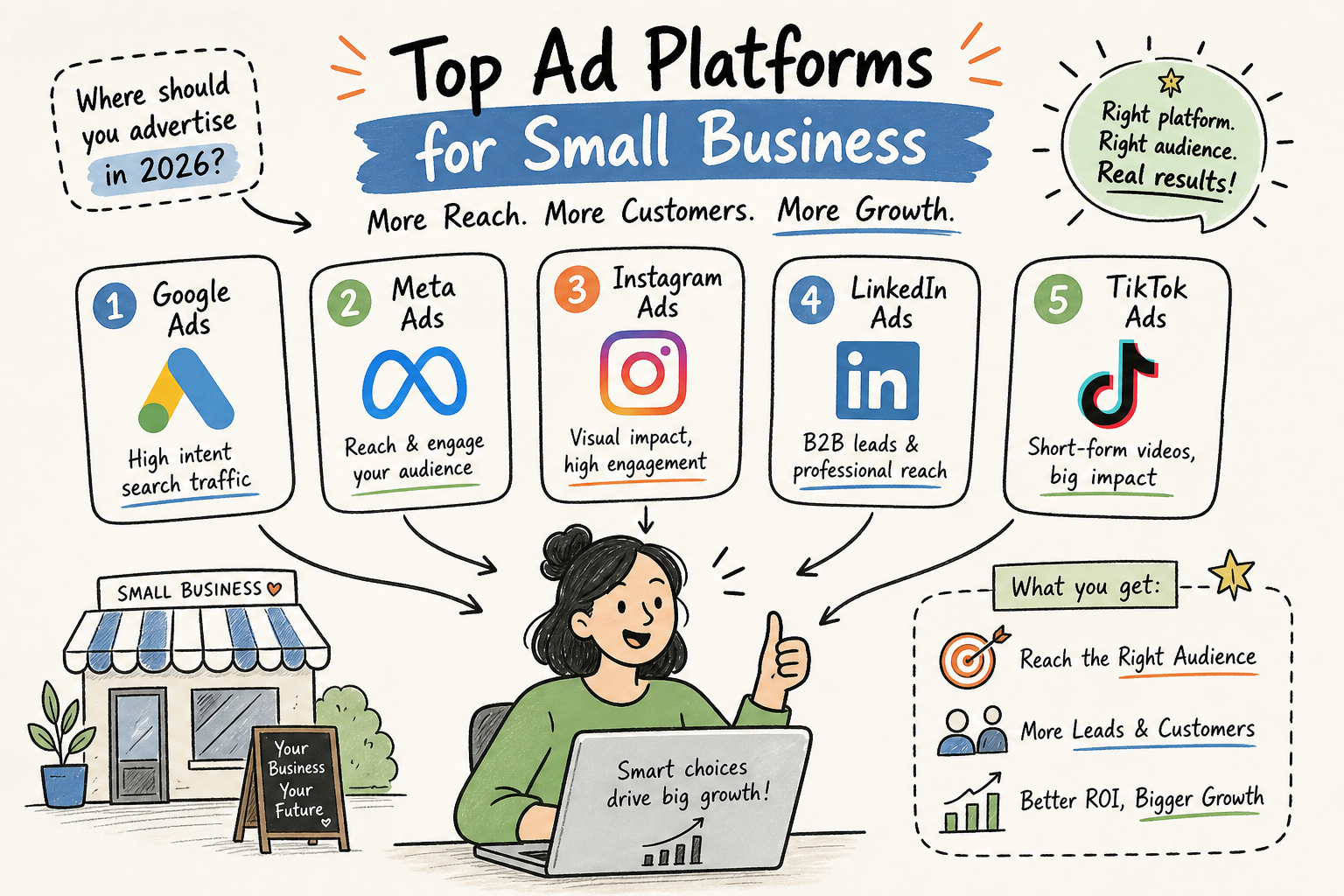
Find the best ad platforms for small business growth. Levree compares top advertising channels to maximize your budget.
Choosing the best ad platform for small business growth is harder than it looks, most owners pick based on what worked for a competitor or a post they saw online, not based on their own business model, buyer behavior, or monthly budget reality. That guesswork burns through ad spend fast, and by the time the data shows it isn't working, the damage is done. At Levree, we've seen this pattern repeat across dozens of SMB campaigns: the platform rarely is the problem. The mismatch is.
This breakdown covers the six major small business advertising platforms available in 2026: Google Ads, Local Service Ads, Meta (Facebook and Instagram), TikTok, LinkedIn, and Pinterest. By the end, you'll know which one or two platforms actually fit your business type, what a realistic monthly budget looks like on each, and what results you can reasonably expect. You'll also get a four-point pre-launch checklist to avoid the most common setup mistakes before you spend a single dollar.
Why platform-goal misalignment costs more than a small budget ever will
Every ad platform operates in one of two modes: demand capture or demand creation. Intent-based platforms like Google and Local Service Ads capture people who are already searching for a solution. They have a problem, they're typing it into a search bar, and your ad meets them at that exact moment. Interest-based platforms like Meta, TikTok, and Pinterest work differently, they surface your offer to people who aren't looking for it yet, which means your ad has to create desire before it can convert it. Most small businesses need to know which mode fits their offer before they choose a platform, because running a discovery-stage creative on a search platform, or a high-consideration B2B offer on TikTok, will consistently underperform regardless of budget.
Three questions narrow down the right choice faster than any benchmark chart. First: are your buyers actively searching for what you sell, or do they need to discover it exists? Second: what does a conversion actually look like for your business, a phone call, a form fill, or a direct purchase? Third: what can you realistically spend per month without pulling from operations? These three questions eliminate the wrong platforms before you look at a single cost figure. They also prevent the most expensive mistake in small business advertising: funding a platform your buyer isn't on.
Google Ads and LSAs: the best ad platform for small business buyers who are already looking
Google Search Ads work best when your buyer is typing a specific problem or service into a search bar. Average CPC runs $2.96 to $4.22, with search conversion rates between 4.4% and 7% (based on platform-reported industry averages). Those numbers make it one of the strongest PPC platforms for small business lead generation, particularly in categories like healthcare, legal services, home services, and anything with a "near me" search pattern. If someone types "emergency plumber Dhaka" or "dentist accepting new patients," Google Search is where you want to be.
Local Service Ads are worth separating from standard Google Search because the economics work differently. LSAs operate on a pay-per-lead model rather than pay-per-click, which means you only pay when a potential customer actually contacts you through the ad. They appear above standard search results, require Google verification (licensing, insurance, and background checks depending on category), and deliver calls directly to your business. Eligible categories span home services, healthcare, legal, tutoring, pet care, beauty, and automotive services. ( see which industries can use Local Service Ads ) For businesses new to paid advertising, LSAs are the lower-risk entry point , with leads typically running $15 to $40, compared to roughly $84 per lead for dentists and $90-plus for home improvement on standard Search.
Effective Google Search campaigns for small businesses generally require $1,000 to $2,000 per month to generate consistent leads and gather enough data to optimize. That budget buys data in the first 60 to 90 days, not certainty. Managing that expectation upfront is the difference between businesses that stick with a platform long enough to see results and those that quit just before the algorithm finds its footing.
Meta Ads: where most small businesses get the strongest cost-per-lead
Meta runs Facebook and Instagram under one ad platform, and the combined targeting depth is what makes it the most cost-efficient starting point for the majority of small businesses. CPC averages $1.06 to $1.72, CPM runs $7.74 to $12.47, and cross-industry conversion rates reach 7.72% to 9.21% (per platform-reported averages). Average CPL for small business lead gen campaigns lands around $25 to $40, with a practical working range of $20 to $80 depending on industry and offer quality. Those numbers are hard to match on any other SMB ad platform at the same budget level.
The best-fit business types on Meta are e-commerce brands, local service providers with strong visual offers (gyms, salons, clinics, restaurants), and B2C lead-gen businesses. Meta works better for discovery-driven offers than for high-intent searches, so if your product or service needs to be seen before it's wanted, this is where you start. Instagram placements generally outperform Facebook feed for younger audiences and visually driven products, while Facebook feed still tends to deliver lower CPL for service-based lead generation.
Creative format matters more on Meta than on almost any other platform. For feed placements, 1080×1080 (1:1) and 1080×1350 (4:5) images perform consistently well. Stories and Reels run best at 9:16. Video between 5 and 15 seconds outperforms longer cuts for most SMB campaigns. Primary copy should stay under 125 characters. A starting budget of $500 to $1,500 per month can generate early data, but $1,500 to $3,000 per month is where the platform starts producing statistically useful test results. (For an overview of effective creative ad formats , see this guide.)
TikTok, LinkedIn, and Pinterest: when niche platforms beat the default choices
TikTok's average CPC sits around $1.04 with a CPM of $10.18, but e-commerce conversion rates average only 1.2%, which means volume and creative quality carry the weight. The platform rewards short vertical video under 30 seconds, UGC-style content, and founder-led storytelling. It's a strong fit for product-based brands in fashion, food, beauty, and impulse-purchase e-commerce targeting 18 to 34-year-olds. Campaign minimums run roughly $50 per day for centralized budget setups, putting a realistic starting budget at $600 to $1,500 per month. For the right product category, TikTok delivers reach among younger audiences that Meta's costs can't match. (For practical tips on creating high-performing creatives on TikTok see this guide.)
LinkedIn is the most expensive platform in this group, with CPC averaging $5.40 and CPM at $33.80. E-commerce conversion rates are only 0.4%, but that metric is irrelevant for B2B lead generation, where LinkedIn's targeting by job title, seniority, industry, and company size is unmatched. Average CPL for B2B small businesses targeting decision-makers runs $90 to $120, with Lead Gen Forms coming in lower than landing page conversion campaigns. Book Demo and Download CTAs consistently outperform generic Learn More for B2B offers. Budget floor is $1,000 to $2,000 per month, anything less gives the algorithm too little signal to optimize effectively.
Pinterest offers the lowest CPC ($0.83) and CPM ($9.20) in this group, with e-commerce conversion rates averaging 1.8%. It works best for home decor, weddings, fashion, food, and fitness categories where buyers are in a planning or discovery mindset. Pinterest's 89.9 million U.S. users skew toward 25 to 44-year-olds and are female-dominant, making it highly targeted for specific niches without the premium cost of LinkedIn. For the right product category, it delivers strong return at a fraction of what other social media ads for SMBs typically cost. (See recent Pinterest user demographics and stats .)
Choosing the best ad platform for small business: matching each channel to your business type and budget
The core matching logic comes down to three business types. Local service businesses should start with Google Search or LSAs, then add Meta as a secondary channel for awareness and retargeting. E-commerce brands typically perform best on Meta first, then layer in TikTok for younger audience reach or Pinterest for lifestyle and home product categories. B2B businesses start with LinkedIn for precision targeting and add Google Search for branded and competitive terms. For lead generation across verticals, Meta and Google are the strongest starting pair across most best ad networks for small businesses.
Budget tiers determine what each investment actually buys:
- $1,000/month: one primary platform, limited creative testing, early validation data only
- $3,000/month: Google plus Meta with room to test multiple audiences and creative variations
- $5,000 to $6,000/month: genuine multi-platform setup where each channel gets enough spend to optimize
At lower tiers, the main output is learning data: CTR, CPC, conversion rate, and cost per lead. That data is valuable, but it isn't scaled profit yet. Businesses that quit a platform after 30 days almost always quit before the algorithm has enough signal to find efficiency. Managing this expectation from day one determines whether campaigns survive long enough to work.
Your pre-launch checklist: four things to lock in before you spend a dollar
Step 1: Set a monthly budget with a 90-day runway in mind. Algorithms across every platform in this list need time to optimize. Most small businesses see meaningful performance shifts between weeks four and eight. Committing to 90 days per platform removes the temptation to pull spend before the data matures.
Step 2: Define your targeting and match it to platform strengths. Audience-first thinking means your target buyer should dictate which platform you're on, not the other way around. For Google, build around keyword intent. For Meta, start with interest and behavioral layers, then build lookalike audiences once conversion data exists. For LinkedIn, use job title and seniority as the primary filters before layering in industry or company size.
Step 3: Prepare platform-matched creative before launch. A mismatched creative kills campaigns before the algorithm learns anything. Use correct aspect ratios, keep video under 15 seconds for Meta and TikTok, write a benefit-led headline, and include one clear CTA per ad. Don't repurpose a landscape image for a Stories placement and expect it to perform.
Step 4: Build a measurement plan before you go live. Define success metrics upfront: CPL for lead gen, ROAS for e-commerce, CPA for direct sales. Install conversion tracking through Google Tag Manager or Meta Pixel before a single dollar is spent. Without this, you're flying blind and optimizing toward the wrong signals. For businesses that want this entire setup handled correctly from day one, working with a performance-focused agency like Levree eliminates the guesswork and significantly accelerates the learning curve across every platform covered in this guide.
The platform that fits your business beats the platform everyone else is using
The decision framework is straightforward: match your platform to your buyer's behavior (searching versus discovering), your business type (local service, e-commerce, or B2B), and your monthly budget tier. Google and Meta cover the majority of small business advertising needs. TikTok, LinkedIn, and Pinterest fill specific gaps for the right categories and audiences.
The best ad platform for small business is not the one with the most users or the lowest CPC. It's the one aligned with how your buyer makes decisions and what your business can sustain for at least 90 days. Start with one platform, build a measurement system, and only expand once your first channel is profitable and consistent.
If you're not sure where to start, or you want a team that has already run these campaigns across dozens of small business categories, Levree offers hands-on campaign setup and optimization built around your specific goals and budget. No guesswork, no mismatched platforms, just performance data that compounds over time.

Leave a comment
Your email address will not be published. Required fields are marked *