


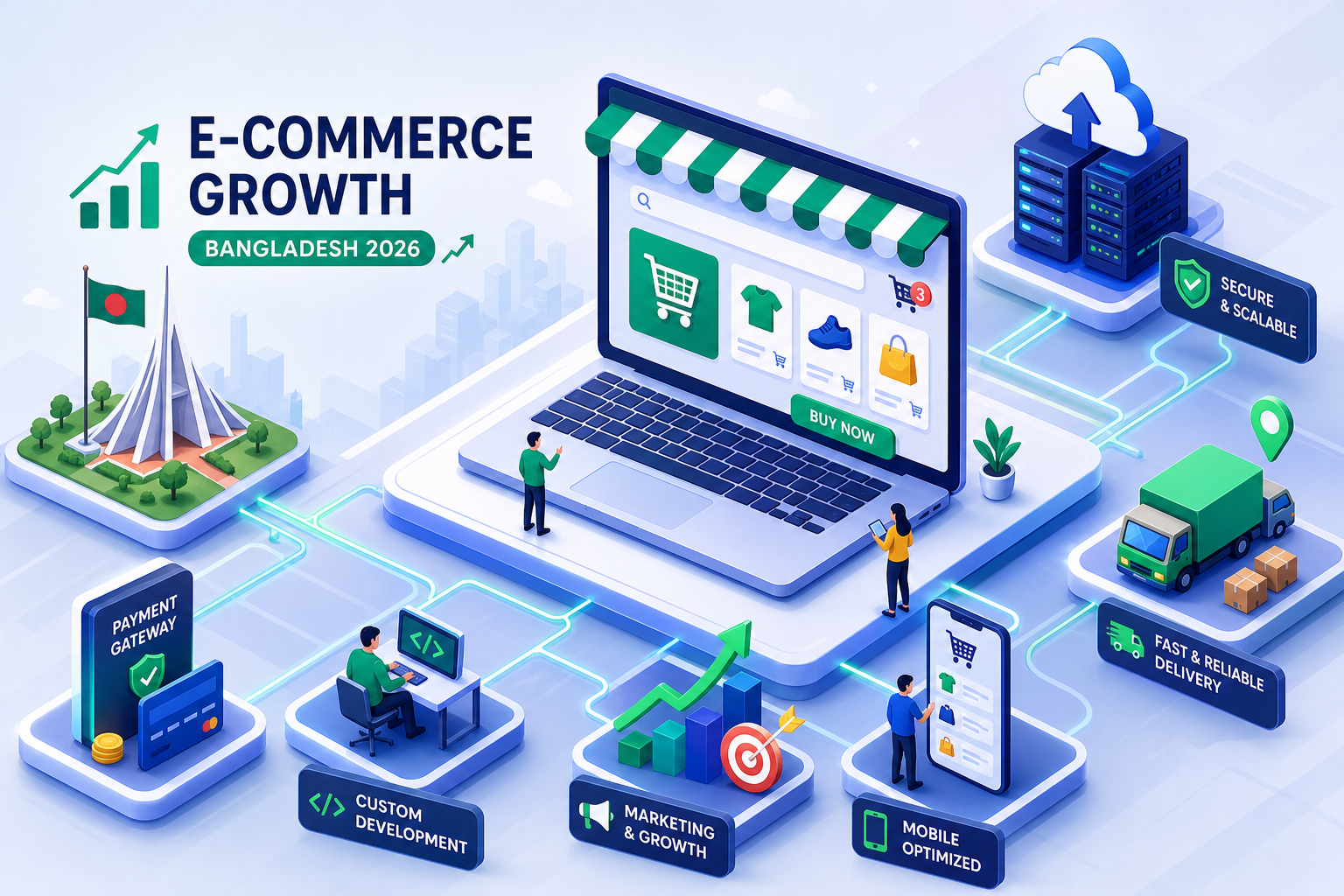
Compare Daraz vs your own website in 2026. Levree explains costs, control, branding, and long-term business growth.
The Daraz vs own website decision is one of the first real tradeoffs Bangladeshi sellers face, and getting it wrong at the wrong stage costs actual money. Daraz gives you access to over 17 million monthly visitors in Bangladesh before you spend a single taka on marketing. Your own website gives you a business asset you actually own, with margins, customer data, and brand equity that compound over time. Neither option is universally right.
This guide breaks down the actual fee structures, traffic dynamics, customer data ownership, and long-term scalability tradeoffs so you can make a decision based on your business stage and goals, not just what feels easiest right now.
At Levree, we work with Bangladeshi e-commerce brands at both ends of this decision: sellers just starting out on Daraz, and established brands ready to build stores they fully own. What we see repeatedly is that the wrong choice at the wrong time erodes margins and delays real growth. Here's how to make the right call.
What it actually costs to sell on Daraz
The zero listing fee makes Daraz look like a low-cost entry point, and for pure discovery, it is. But the real cost structure kicks in the moment you make a sale, adding up faster than most sellers realize.
Daraz vs your own website: how marketplace fees stack up
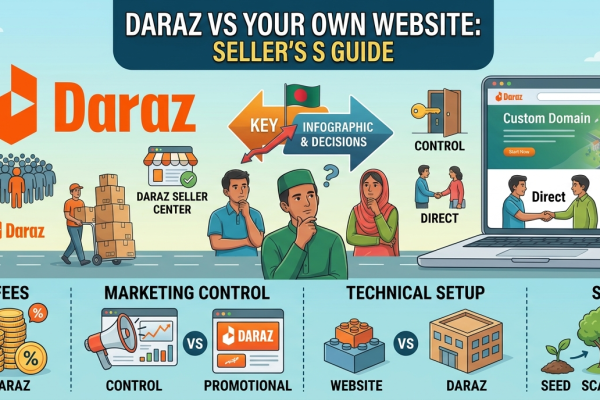
Daraz Bangladesh charges category-based commissions ranging from 0% to 17.2%, and most common product categories sit in the 8.6% to 17.2% range. Daraz commission structure documentation shows the category breakdown in detail. Fashion items carry a 17.2% commission. Bedding and home décor sit at 12.9%. Medical supplies and bags land at 8.6%. On top of commission, every seller pays a 2.25% payment processing fee plus an item handling fee on each transaction.
Run the math on a practical example: a fashion item priced at BDT 1,000 incurs 17.2% commission plus 2.25% payment fee plus handling. Your platform take easily reaches 20, 22% before you've touched product cost, packaging, or courier fees. On a BDT 1,000 sale, you're keeping less than BDT 800 before a single operational cost. Most sellers overlook this when they see "no listing fee" on the Daraz seller page.
The cost of visibility on a crowded marketplace
Daraz's built-in traffic doesn't translate to automatic sales. With thousands of sellers competing in every category, most serious Daraz sellers invest in sponsored listings, flash sale participation, and discount-heavy promotions just to maintain visibility. These aren't optional extras, they're operating costs for anyone trying to grow on the platform.
These soft costs rarely appear in the standard fee breakdown, but they erode margins significantly over time. A seller running 15, 20% commission plus sponsored ad spend plus periodic discounts can find themselves at thin margins even on healthy revenue. Selling on any marketplace at scale carries this structural reality.
What building your own online store actually costs
The upfront numbers on an independent store look more expensive than Daraz's zero listing fee. But the cost structure works differently, and that difference becomes significant once you understand the breakeven logic.
Setup costs and monthly platform fees
A professionally built WooCommerce store in Bangladesh typically costs BDT 40,000 to 180,000 to develop, with monthly hosting and maintenance running BDT 7,000 to 25,000. Shopify runs slightly higher, with development costs from BDT 60,000 to 250,000 and monthly costs of BDT 12,000 to 35,000 once you factor in the plan, apps, and a local payment gateway. See Shopify's guide to e-commerce website cost for a breakdown of typical development and recurring expenses.
Bangladeshi sellers considering Shopify should know upfront: Shopify Payments is not available in Bangladesh, so you'll need a third-party gateway regardless of which plan you choose. Popular options like SSLCOMMERZ charge around 2.5% per transaction, while aamarPay runs 2.55% to 3.25% for cards, with lower rates for mobile wallets like bKash and Nagad. For an overview of common payment gateways in Bangladesh and their fee structures, consult local gateway comparisons when planning your integration. That integration adds both setup cost and ongoing transaction fees that need to factor into your monthly operating budget.
What you're actually buying with that cost
Unlike Daraz fees, a recurring percentage taken on every single sale, your own store's costs are largely fixed. At a certain order volume, your per-sale cost on your own website drops far below what Daraz takes per transaction. The breakeven point depends on your category and marketing efficiency, but fixed costs structurally outperform percentage-based fees as you grow.
On Daraz, every additional sale carries the same platform fee. On your own store, every additional sale improves your unit economics because your fixed costs stay constant. Growth-stage brands find their own store becomes significantly more profitable per transaction as volume scales. Levree builds high-converting WooCommerce and custom e-commerce stores for Bangladeshi brands, so you're not piecing together infrastructure alone when you make that move.
Daraz vs your own website: traffic, customers, and who owns the relationship
Most sellers underestimate the long-term cost of staying marketplace-only, and the customer data gap is where it shows up most clearly.
Daraz's built-in audience is real but it's not yours
Daraz Bangladesh receives between 9 million and 17 million monthly visits, based on third-party measurement tools including SimilarWeb estimates . That's a genuine acquisition advantage for new sellers who have no existing audience, no SEO footprint, and no marketing budget to generate traffic from scratch. The platform's estimated conversion rate of around 2.8% is competitive for a marketplace environment, buyers are already in purchase mode when they land on Daraz, which makes conversion easier than on a cold independent store.
But every buyer who converts on Daraz belongs to Daraz, not to you. You don't get their email address, their phone number, or their purchase history. You can't retarget them or reach out when you launch a new product. The transaction happened, but the relationship belongs to the platform.
Why owning customer data changes your entire growth trajectory
On your own store, every buyer is a first-party data asset. You can retarget them on Facebook and Google, build email sequences that drive repeat purchases, and create loyalty programs that increase lifetime value, none of which a Daraz seller can do. A brand running 500 orders a month on Daraz has zero CRM equity to show for it. The same 500 orders on your own store builds a remarketing list, a repeat purchase engine, and an audience that compounds in value with every additional order.
This is the single biggest long-term cost of staying marketplace-only: not the fees, but the customer relationships you're not building. Every order on Daraz is a transaction that resets to zero. Every order on your own store is a relationship you can grow.
Brand control and long-term scalability
The economics matter, but so does what you're building toward. A Daraz store and your own website represent fundamentally different strategic assets, and confusing them is a growth mistake.
What you give up on a marketplace
On Daraz, your product lives inside a standardized listing template. You control the photos and the description, but the checkout flow, post-purchase communication, and overall brand environment all belong to Daraz. Your brand doesn't exist on that page in any meaningful way, your product exists inside Daraz's brand.
Competing on Daraz means competing on price, reviews, and promotion timing. For commodities and high-volume categories with thin differentiation, that works. For any brand trying to build premium positioning, create emotional connection with buyers, or command price premiums based on brand equity, a marketplace-only approach is a ceiling, not a launchpad.
Building equity vs renting shelf space
Your own website is a brand asset that appreciates. SEO traffic compounds over time, return customers increase as your CRM grows, and brand recall builds as your visual identity becomes consistent across every touchpoint. A marketplace presence works more like a rental: ease off promotions or get outpriced by a competitor, and your visibility drops immediately.
For Bangladeshi businesses with genuine long-term ambitions, scaling beyond Bangladesh, attracting investment, or building a recognizable consumer brand, an independent e-commerce site isn't optional. It's the foundation everything else is built on. Multi-channel selling, running both Daraz and your own store simultaneously, is increasingly common among mid-stage brands when the strategy is intentional: Daraz for discovery and acquisition, your own store for retention, margin, and brand equity.
Daraz vs your own website: a practical decision framework
The right channel depends on your stage, your category, and what you're optimizing for right now. Here's how to think through the decision without overthinking it.
When Daraz is the right starting point
- You're validating a new product or category and need real buyer data before you can justify a marketing budget.
- Your average order value is low and your category is high-volume, making marketplace discovery genuinely valuable.
- You don't yet have the operational bandwidth to manage your own store's traffic acquisition through SEO or paid ads.
Starting on Daraz to validate demand and build initial cash flow is a sound strategy. The mistake is staying there past the point where the fees and constraints start limiting what you can build.
When your own store is the smarter move
- You're doing consistent monthly sales and watching Daraz fees take 15, 20% of revenue on every order.
- You want to build a recognizable brand, not just move units through someone else's platform.
- You're ready to invest in SEO, paid advertising, or email marketing to own your traffic channel.
- You're planning to scale regionally or build a brand with equity beyond Daraz's ecosystem.
At this stage, every order you keep on Daraz is a missed opportunity to build the CRM, brand equity, and margin efficiency your own store provides. Daraz's familiarity isn't a reason to stay.
The multi-channel approach: running both
Many growth-stage Bangladeshi brands run Daraz for volume and discovery while building their own store for margin and brand equity at the same time. This works when the strategy is intentional: Daraz handles top-of-funnel acquisition and category discovery, while your own store drives retention, repeat purchases, and the customer relationships Daraz won't let you own. The risk is splitting focus too early before you have the operational capacity to run both well.
When you're ready to build a high-converting, fully branded e-commerce store you actually own, Levree builds custom WooCommerce and e-commerce solutions for Bangladeshi brands, from UX design and development to SEO and paid traffic setup. You don't just get a website; you get a complete growth system built to convert. Talk to the Levree team about your e-commerce build.
The decision that compounds over time
Daraz vs your own website isn't really a question of which is better. It's a question of where you are right now and what you're optimizing for. Early-stage sellers gain real value from Daraz's built-in audience and zero-barrier entry. Growth-stage brands find that every month they stay marketplace-only is a month of customer data, brand equity, and margin efficiency they're leaving behind.
The brands winning in Bangladesh's e-commerce market in 2026 are the ones who understood this distinction early. They used Daraz strategically for what it's genuinely good at, then built assets they actually own. Daraz can be a chapter in that story. It shouldn't be the whole story.
If you're at the point where building your own store is the next move, Levree can get you there.



Leave a comment
Your email address will not be published. Required fields are marked *