


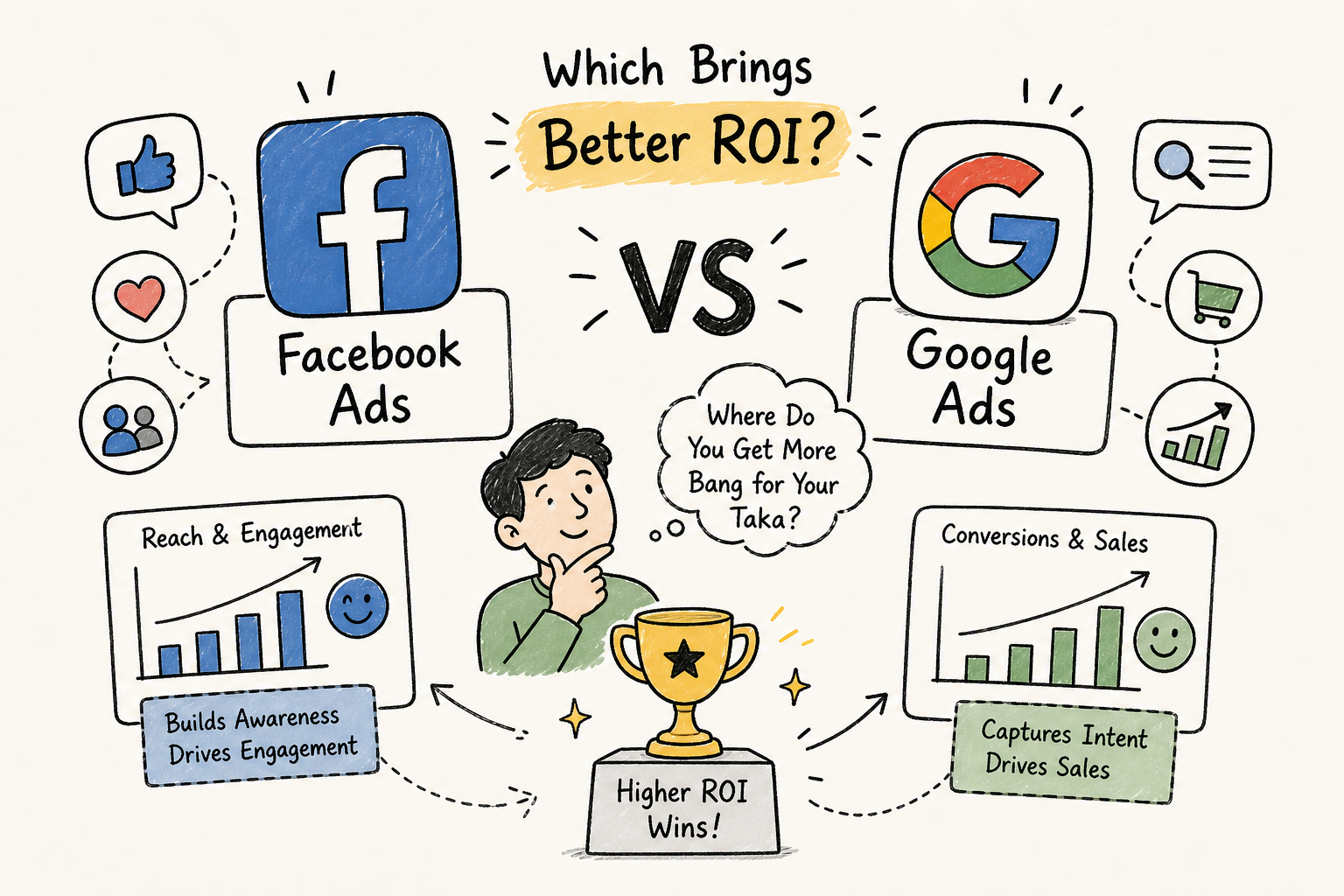
Compare Facebook Ads vs Google Ads in Bangladesh. Levree helps you choose the best platform for leads, sales, and growth.
Which is better, Facebook Ads or Google Ads for Bangladeshi businesses? It's the question most local advertisers face the moment they commit to a paid budget, and in our experience working with clients across healthcare, e-commerce, and professional services, most make that choice based on gut feeling, a competitor's guess, or whatever a vendor happens to be selling. That can result in wasted spend on the wrong platform for the wrong stage of the funnel.
The real issue isn't that one platform is universally better. It's that Facebook and Google serve completely different buyer behaviors, and your business model determines which one moves the needle. At Levree, we've managed paid campaigns across both platforms for Bangladeshi clients, and the performance data tells a very specific story.
This article gives you three concrete things: real cost benchmarks in BDT, a clear breakdown of which industries belong on which platform, and a practical framework to decide how to spend or split your budget.
How Facebook and Google reach your customers differently
These two platforms are not fighting for the same attention. They intercept buyers at completely different stages of their decision-making process, and treating them as interchangeable is one of the most expensive mistakes businesses make.
Facebook operates on identity and behavior. With 73.3 million Facebook users in Bangladesh as of early 2026, representing 40.6% of the total population, it's the dominant social platform in the country. The audience skews male at 62.8%, with the 18, 24 age group as the largest cohort followed closely by 25, 34. When you run Facebook Ads, you're targeting based on who someone is: their demographics, interests, and behaviors. You're reaching them before they've searched for you. This is demand creation, not demand capture.
Google works the opposite way. Search Ads intercept users who are actively typing a query, which means intent is already established. A person searching "physiotherapist in Dhaka" or "best private clinic Gulshan" is not browsing, they are ready to act. YouTube, meanwhile, reaches a broad Bangladeshi audience and allows interest and intent targeting at scale. According to DataReportal's Digital 2026 Bangladesh report , 49.8 million users are reachable through YouTube ads in Bangladesh. For businesses where customers search before they buy, this is a significant structural advantage.
The distinction matters before you spend a single taka. A fashion brand triggers discovery behavior. A medical clinic triggers search behavior. These two businesses should not be running the same platform strategy, and the cost of ignoring that difference shows up in your CPA every month.
Which is better, Facebook Ads or Google Ads for Bangladeshi businesses? Start with cost.
Cost-per-click is the most commonly cited metric in ad conversations, and also the most misleading one when used in isolation. Here's what the data actually shows.
Facebook/Meta Ads in Bangladesh have a broad CPC range of 5, 20 BDT for general campaigns. Industry-level costs, however, are significantly higher, and it's worth understanding why. The 5, 20 BDT figure represents a median or low-end range across mixed campaign types, while per-industry CPCs reflect more competitive targeting in specific verticals. According to Ngital's Bangladesh ad benchmark data , the breakdown by sector looks like this:
Industry | Facebook CPC (BDT) | Facebook CPA (BDT) |
Apparel | ~170 | , |
Health & Medical | ~130 | ~5,909 |
Technology | ~200 | ~6,896 |
Finance | ~35 | ~2,916 |
Real Estate | , | ~4,000 |
These figures assume optimized campaigns with proper audience targeting and creative testing.
For Google Ads in Bangladesh, Google does not publish region-level CPC benchmarks for Bangladesh specifically, which is why granular local data is limited. The directional pattern from available search data is clear: Google Search carries a higher CPC than Facebook in most categories because of the intent premium built into search behavior. Competitive sectors like legal, finance, and healthcare typically see higher CPCs but also higher-quality leads, because users are further along in their buying decision.
Lower CPC does not mean lower cost per lead. A 130 BDT Facebook click that converts at 1% costs 13,000 BDT per acquisition. A 300 BDT Google click that converts at 5% costs 6,000 BDT per acquisition. The metric that actually matters is cost per qualified lead or cost per sale, and that number lives at the campaign level, not in a benchmark table. Also worth noting: Bangladeshi businesses buying ads on either platform should account for 15% VAT on digital advertising payments , which can be withheld at the bank level, your effective budget is smaller than the number you fund.
Industry fit: Facebook vs Google Ads for Bangladeshi businesses
This is the question most business owners actually need answered. Platform fit isn't about preference; it's about how your customer behaves before they become a customer.
Facebook performs better for demand-creation businesses. Fashion and apparel brands, lifestyle products, consumer goods, and e-commerce shops benefit from Facebook's visual, scroll-based format. Social commerce is deeply embedded in Bangladesh, with Facebook functioning as a primary shopping discovery channel across most consumer categories. Brands building audiences, running retargeting sequences, or selling impulse or lifestyle products see strong ROAS on Facebook. Meta e-commerce case studies have documented ROAS scaling from under 2x to over 6x in well-structured funnels, a range consistent with what structured retargeting campaigns can achieve when audience segmentation and creative sequencing are properly built out. Facebook tends to work well for: clothing brands, food delivery, beauty and personal care, home décor, and direct-to-consumer products.
Google performs better for intent-led service businesses. Healthcare clinics, dental practices, law firms, educational institutions, and financial advisors benefit from capturing people who are already searching for a solution. A search query like "specialist doctor Gulshan" or "MBA admission Dhaka" represents a buyer who is ready to act. Google's healthcare CPC is typically higher than Facebook's, but the lead quality reflects that difference. This platform tends to work well for: clinics, consultants, real estate agents, coaching centers, and B2B service providers.
Some businesses benefit from running both platforms with distinct roles. E-commerce at scale works best with Google capturing active searchers and Facebook retargeting visitors and expanding reach. SaaS and tech businesses use Google for direct lead capture and Facebook for brand awareness and audience nurturing. The key is assigning each platform a specific job rather than running the same message on both and hoping for overlap.
ROI and conversion rates: what real campaigns show
Benchmarks are useful as context. Campaign data from actual Bangladeshi businesses is more useful as a decision tool.
Paid social campaigns on Facebook in Bangladesh typically see click-to-conversion rates of 1, 3%, depending on the offer, audience temperature, and creative quality. Cold audiences convert at the low end; retargeting audiences can push well beyond 3% with the right sequence. Paid search on Google averages higher conversion rates because of intent. Based on WordStream's 2026 industry benchmarks, Google Search conversion rates sit at 5% or above across several categories, though e-commerce typically runs closer to 2, 3%.
From Levree's own client campaigns in Bangladesh, Google PPC has delivered a 320% ROI for intent-led service businesses, particularly in healthcare and professional services, based on aggregated data across campaigns run over the past 12 months. Facebook campaigns for the same clients produced stronger reach, lower CPM, and better audience growth, but required longer nurturing cycles to achieve comparable revenue outcomes. These are internal campaign observations rather than published benchmarks, but the directional pattern is consistent with how both platforms are designed to function. Google closes. Facebook builds.
ROAS expectations vary by business model. E-commerce brands running Meta retargeting alongside Google Shopping consistently see the highest combined ROAS. Pure Google-only strategies perform best for local service businesses with clear, established search demand. Pure Facebook-only strategies work for early-stage brands building an audience before significant search volume exists for their category.
A practical framework to pick your platform (or split your budget)
Analysis only becomes useful when it turns into a decision. Use these three questions to determine where your budget belongs.
- Do your customers search for your product, or do they discover it while scrolling? Search intent points to Google. Discovery behavior points to Facebook.
- What is your funnel stage? Building brand awareness from zero points to Facebook. Generating leads from active buyers points to Google.
- What is your monthly ad budget? Below 15,000 BDT, test one platform based on your answers above, splitting a limited budget across two platforms typically prevents either from reaching the learning threshold needed for algorithm optimization. Above that, run a structured split test.
A practical starting point for most SMBs: allocate 60% of budget to the primary platform based on your answers, and 40% to the secondary. Run both for 4, 6 weeks before drawing conclusions. Algorithm learning periods affect early results on both platforms, and pulling budget too early skews the comparison.
Before you scale spend on either platform, run through this measurement checklist:
- Are UTM parameters tracking platform source and campaign correctly in your analytics tool?
- Is the Meta Pixel or Google Tag firing correctly on all key pages, including thank-you and confirmation pages?
- Have you defined a specific conversion event (form submission, call, purchase) with a target CPA in BDT before the campaign launches?
- Are you reviewing performance at the campaign and ad-set level, not just at the account level?
In our experience auditing underperforming campaigns, measurement failures are a common reason campaigns fall short, not the media itself. If you can't trace a lead back to a specific campaign and audience, you're optimizing blind.
The real answer isn't Facebook or Google, it's both, in the right order
When businesses ask which is better, Facebook Ads or Google Ads for Bangladeshi businesses, the honest answer is that it depends on where your customer is in the buying journey. Facebook builds demand for brands that customers discover. Google captures demand from customers who already know they need a solution. Most businesses that scale past a certain point end up using both, but with clearly defined roles and separate success metrics.
Use Facebook for discovery-led products and audience building. Use Google for intent-led services and fast lead generation. Use both when you're ready to run a full-funnel strategy with proper attribution in place. The businesses that win in Bangladesh's paid advertising landscape aren't the ones spending the most, they're the ones matching the right platform to the right stage of the buying journey.
At Levree, we've worked through this exact question with Bangladeshi clients across healthcare, e-commerce, and professional services. We've built the campaign frameworks, benchmark data, and measurement infrastructure that make both platforms perform. If you want a clear recommendation on which is better, Facebook Ads or Google Ads for your specific business model and budget, get in touch with us and we'll tell you exactly where your next taka should go.
Leave a comment
Your email address will not be published. Required fields are marked *