


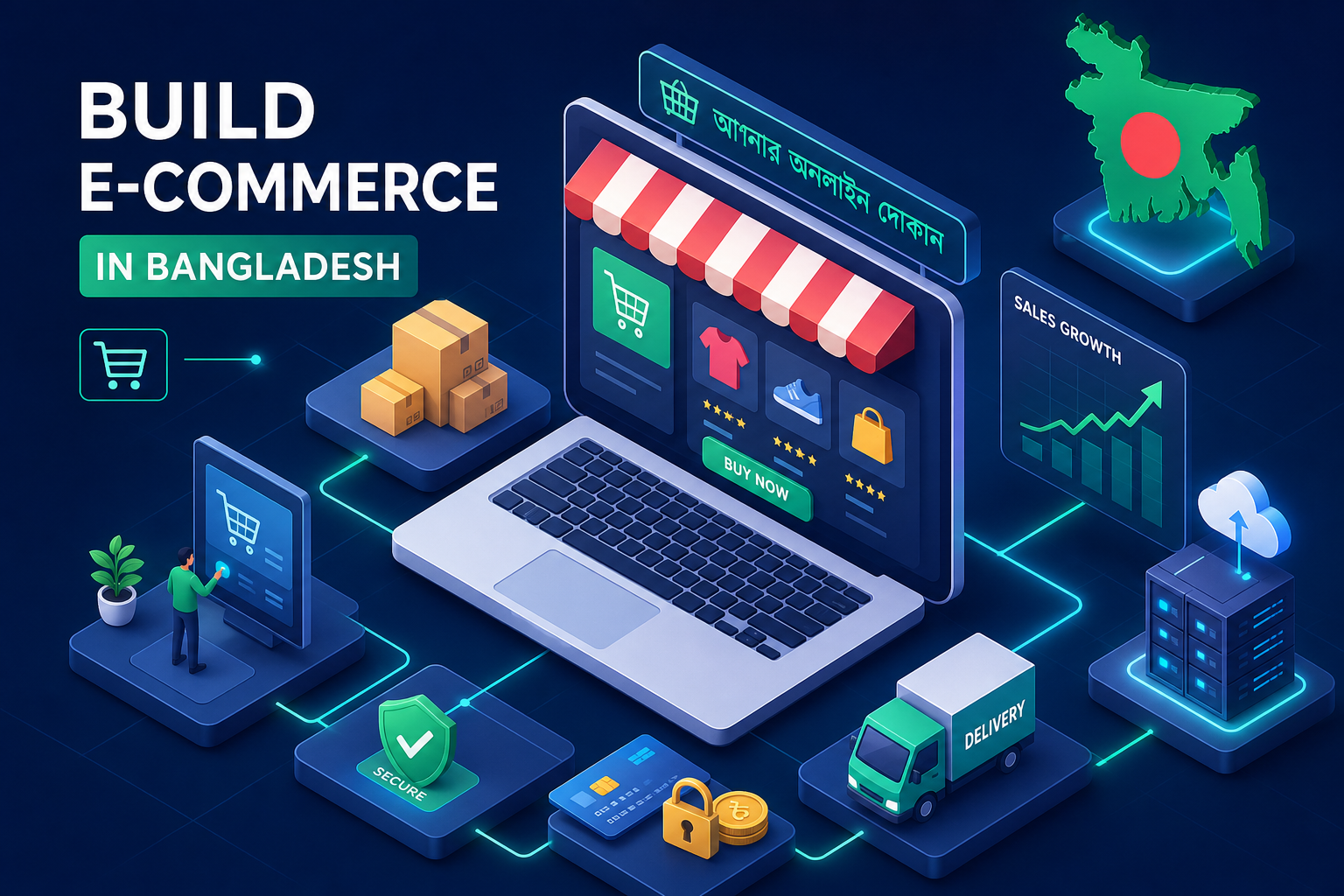
Learn how to build an e-commerce website in Bangladesh. Levree covers planning, design, payments, and growth strategies.
If you're wondering how to build an e-commerce website for your business in Bangladesh, you're not alone, and the answer is more straightforward than the noise online suggests. Bangladesh's online shopping audience has grown rapidly in recent years, with millions of new buyers entering the market annually. Despite that growth, most business owners who decide to launch an online store hit the same wall: they know they need a website, but they don't know which step comes first. The information they need is scattered across Facebook groups, developer WhatsApp chats, and conflicting blog posts that each answer one question while ignoring the other five.
Whether you're selling fashion, electronics, homemade food, or professional services, the core setup is the same. You need a domain and hosting, the right platform, legal registration, local payment gateways, and a courier that handles Cash on Delivery reliably. Some businesses in Bangladesh handle this themselves piece by piece. Others work with end-to-end development partners who handle the entire build as an integrated system. This guide walks through both paths clearly so you can decide which fits your situation.
Start with domain registration and hosting
Picking the right domain name for your store
Your domain is your store's permanent address, so the decision deserves focused thought rather than prolonged second-guessing. For most Bangladeshi businesses, a .com is widely perceived as carrying broader recognition than a .com.bd, even domestically, though .com.bd has its own local authority appeal. If you want a .com.bd, budget roughly BDT 700, 1,100 per year through BTCL or an accredited registrar like XeonBD, though some resellers charge BDT 4,000 for a two-year registration. A standard .com runs roughly US$10, 15 per year through registrars like Namecheap or GoDaddy. Keep the name short, skip hyphens, and avoid creative spellings that customers will misspell when typing directly.
Hosting options that handle Bangladeshi traffic
Shared hosting works for a new store with light traffic, but managed WordPress hosting is the smarter starting point if you're building on WooCommerce. Providers like Hostinger and SiteGround offer plans that scale without requiring you to manage server configuration manually. Performance matters here: Bangladesh is a mobile-first market, and according to Google's mobile speed research, even small improvements in page load time can significantly reduce bounce rates and lift conversions. Slow hosting is a hidden conversion killer , and switching later is painful once your store has live orders and customers.
How to build an e-commerce website for your business in Bangladesh, Platform and costs
WooCommerce, Shopify, or custom: which fits your goals
Three real options exist, and each has a distinct trade-off. WooCommerce is self-hosted on WordPress, gives you full control over code and integrations, and has plugin support for all major Bangladeshi payment gateways. Shopify is a SaaS platform, faster to launch, and easier to manage day-to-day, but it adds a recurring monthly fee starting around ৳2,300 and has less flexibility for local payment customizations. Custom-built stores offer complete control and are the right choice for businesses with complex workflows, multi-vendor requirements, or COD logic that standard platforms can't handle out of the box.
For most Bangladeshi businesses starting out, WooCommerce offers the best combination of flexibility and local integration support. Shopify is a good choice if speed to market matters more than customization. Custom development makes sense when your business model has requirements that neither WooCommerce nor Shopify can handle cleanly.
Realistic cost breakdown for each option
Here's what you should actually expect to spend:
- DIY WooCommerce: ৳15,000, ৳55,000 for a basic setup; ৳50,000, ৳1.1 lakh (approximately ৳1,10,000) for a properly structured store with 50, 200 products, mobile UI, and payment integration
- Shopify setup: ৳50,000, ৳1,50,000 as a one-time setup fee, plus approximately ৳2,300/month in platform fees ongoing
- Agency-built custom store: ৳50,000, ৳2.5 lakh (approximately ৳2,50,000) or more, depending on complexity, custom workflows, and the number of integrations required
These ranges reflect what local agencies and developers actually quote in the Bangladeshi market. The DIY numbers assume you're handling theme setup, product uploads, and payment configuration yourself. Once you factor in your time, the true cost of a DIY build is higher than it looks on paper. For a local perspective on typical website pricing in Bangladesh, see this guide on how much a website costs in Bangladesh .
When your platform choice limits your growth
A wrong platform decision isn't fatal, but reversing it later is expensive and disruptive. If you plan to scale past a few hundred products, need multi-vendor capability, or want custom delivery zone logic, your platform matters more than it seems at launch. Start with WooCommerce if you're unsure of your scale , and structure the build with migration optionality in mind. Don't choose a platform because it looks easy to set up; choose it because it can handle where your store is going in 12 to 24 months.
Legal registrations before you start accepting payments
Trade license, E-TIN, and when VAT registration applies
Operating an online store in Bangladesh without the right registrations creates real business risk, and the process is more straightforward than most people expect. The foundation has three layers.
First, get a trade license from your relevant city corporation or municipality. For Dhaka, this means DNCC or DSCC. The application requires your national ID, a holding tax receipt, a recent photo, a TIN certificate, and your lease agreement. Processing typically takes 3, 7 working days from submission. You can review the official trade license procedure on the Bangladesh Trade Portal for the exact document requirements and steps ( trade license procedure ).
Second, register for an E-TIN with the National Board of Revenue, which you can do online. Third, VAT or BIN registration via Mushak Form 2.1 becomes mandatory once your annual turnover reaches ৳3,00,00,000, or immediately if your business category mandates VAT registration regardless of turnover. Most small online sellers start with a trade license and E-TIN, then add BIN registration as revenue grows. Get the foundation in place before you start processing real customer payments.
E-commerce compliance obligations most sellers overlook
Bangladesh's e-commerce guidelines carry operational requirements that go beyond registration. Transaction records must be retained for at least six years and must be available to authorities on request. Your website must display a visible customer complaint contact, a phone number or email address works. If you operate a marketplace with third-party sellers, payment to those sellers must be settled within 10 days of the transaction. Non-compliance can result in trade license or VAT registration cancellation. These are worth setting up correctly from day one, not retroactively after your store has traction.
Integrating local payment gateways the right way
Comparing SSLCommerz, bKash, Nagad, and aamarPay
Payment gateway selection is one of the most consequential technical decisions in your Bangladesh e-commerce setup. SSLCommerz is the largest payment aggregator in the market and supports the widest range of channels, including cards, mobile wallets, and digital EMI. bKash has the largest wallet user base and is essentially non-negotiable for any retail store; leaving it out means losing a significant share of your checkout conversions. Nagad has grown rapidly and is widely used across various customer segments. aamarPay bundles bKash, Rocket, Nagad, Tap, Upay, and card payments into one integration, which simplifies the technical setup considerably. ShurjoPay is another solid option with competitive transaction rates.
On fees, use these as your baseline for comparison (rates vary by merchant category and contract, confirm directly with each provider):
- aamarPay: Cards at 2.55%, 3.25%; mobile wallets (bKash, Rocket, SureCash) at 1.85%, 2.1%
- ShurjoPay: Visa/MasterCard/Nexus at 2.5%; AmEx at 3.5%; mobile wallets at 2.0%
- Moneybag: Cards at 2.40%; MFS at 1.80%; onboarding fee BDT 10,500
How to get approved and go live with a gateway
Merchant onboarding follows a consistent flow across most providers. Create a merchant account, submit your business documents (trade license, TIN, and a bank cheque leaf for SSLCommerz sole proprietorships, plus an attested passport copy), receive API credentials after approval, test in sandbox, and then go live. WooCommerce has plugins for both SSLCommerz and aamarPay that cut integration time significantly. For custom builds, REST API integration is the standard route. Approval timelines range from a few business days to two weeks depending on the provider, so start the gateway application process early, ideally while your store is still being built. SSLCommerz also offers a practical guide to starting e-commerce in Bangladesh and integrating payment services ( SSLCommerz's comprehensive guide ).
Product listings, shipping, and logistics setup
Product listing practices that actually convert
Most Bangladeshi e-commerce stores lose sales at the product page, not at checkout. The product page has one job: remove every reason the buyer has to hesitate before adding to cart. Write descriptions that cover what the product is, who it's for, and what makes it worth the price. Use multiple images, including at least one lifestyle shot for fashion or lifestyle products. Display pricing clearly alongside any applicable delivery charges. Show your return policy and warranty terms directly on the product page; these are trust signals that reduce hesitation. On mobile, every image and call-to-action button must render correctly at small screen widths, Bangladesh is a mobile-first market and the majority of your customers are browsing on handheld devices.
Choosing a courier and setting up COD
Cash on Delivery remains the dominant payment method for e-commerce in Bangladesh, which means your courier relationship is as important as your payment gateway. RS Express BD is built specifically for e-commerce COD logistics with nationwide coverage and real-time tracking. ICS Express is another specialist courier for online stores. For cross-border orders, established carriers provide guidance on reducing shipping costs and optimizing international logistics, see DHL's strategies for e-commerce success in Bangladesh for practical tips ( reduce your shipping costs ).
Realistic domestic delivery expectations: same-city orders often arrive next day, major city-to-city typically takes 1, 3 days, and remote areas can take up to 7 days. Before signing with any courier, confirm three things: the COD settlement cycle (most providers remit within 3, 7 days after delivery), the failed-delivery charge policy, and the return-to-sender handling process. For a detailed walkthrough of COD remittance and how settlement cycles typically work for online sellers, this resource explains the step-by-step process ( how COD remittance works ). These variables directly affect your cash flow and operational margins.
Build it yourself or work with a development team
When the DIY route makes sense (and where it costs you)
A solo WooCommerce build works well for stores with under 50 products, simple shipping zones, and standard payment methods. If your catalog is straightforward and you have time to troubleshoot, the DIY path is viable. The honest cost of DIY, though, isn't the upfront build; it's the hours spent fixing plugin conflicts, the performance issues from unoptimized code, and the revenue lost from a checkout experience that doesn't convert on mobile. Once you add custom delivery zones, complex product variants, or want to run paid ads to the store and need the funnel to convert, the DIY ceiling becomes a real constraint.
What a full-stack development partner delivers
Working with a full-stack e-commerce development partner means your store launches with local payment gateways already integrated and tested, mobile-optimized UX built for Bangladeshi browsing behavior, legal compliance structure in place, and logistics configured before the first order. Levree builds e-commerce stores for Bangladeshi businesses end-to-end, handling everything from platform architecture and bKash/SSLCommerz integration to product uploads and COD logistics setup. This isn't a luxury for large businesses; it's often the faster and more cost-effective path for any business with real commercial ambitions. When the build is done right the first time, you avoid the expensive migration that typically follows a DIY store that outgrows its original setup.
Putting it all together
The sequence is clear: register your domain, set up hosting that handles mobile traffic, choose a platform based on your scale goals and budget, complete your trade license and E-TIN before accepting payments, integrate local gateways starting with SSLCommerz and bKash, build your product catalog with mobile conversion in mind, and partner with a courier that handles COD and remits on a predictable cycle.
The decisions compound. A platform chosen without considering payment integration will cost you weeks of rework. Skipping legal registration creates risk that surfaces at the worst possible moment. A slow checkout directly reduces the return on every taka you spend on paid ads. The goal isn't a live website; it's a store that converts traffic into revenue and scales without a full rebuild every 18 months.
Building an e-commerce website for your business in Bangladesh doesn't have to mean months of troubleshooting configuration issues on your own. Working with an experienced development team removes the guesswork and gets you to revenue faster. Levree's team handles the full build so you can focus on running your business instead of managing plugins. Talk to Levree about your e-commerce project and get a clear roadmap before you spend a single taka on development.



Leave a comment
Your email address will not be published. Required fields are marked *