


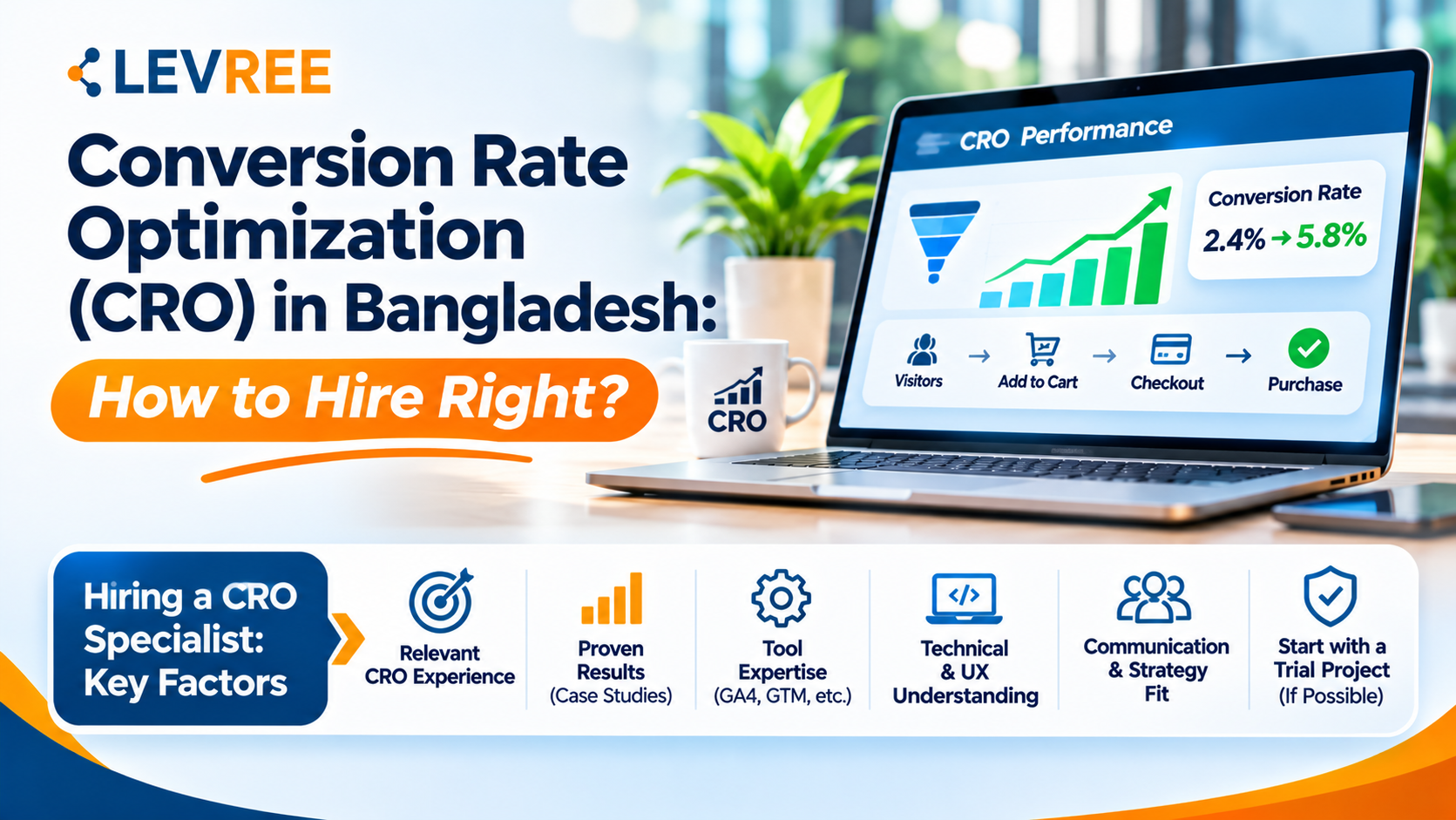
Learn how to hire the right conversion rate optimization expert in Bangladesh. Compare CRO agencies, evaluate experience, understand pricing, and find the right partner to improve website conversions and sales.
Conversion rate optimization in Bangladesh is not a plug-and-play discipline, and the numbers reflect that. Many local sites report conversion rates under 2%, a figure consistent with industry proxies for developing APAC markets, even when they're already running Facebook ads or investing in SEO to drive traffic. The traffic isn't the problem. The problem is what happens after the click: a slow mobile page, a confusing checkout, a trust signal gap that sends the visitor back to Google before they ever see your offer.
Hiring the wrong conversion optimization partner makes this worse, not better. You end up spending months and real budget on redesigned pages and button-color opinions dressed up as strategy, with no baseline, no test data, and no measurable lift to show for it. Levree has been running data-driven CRO audits for Bangladeshi brands and understands how often that story repeats across local funnels.
This guide gives you a clear breakdown of how conversion rate improvement actually works in the local market, what a credible process looks like from audit to test, and the 9 questions that cut through sales talk and reveal whether an agency has a real system or just a polished proposal template.
Why Bangladeshi websites lose conversions differently
Generic CRO frameworks are built on global averages. They assume a broadband desktop user in a high-trust market who pays by credit card. That is not your customer in Bangladesh, and applying those frameworks without local context produces recommendations that look reasonable on paper but do nothing for your actual funnel.
The mobile-first gap most CRO agencies in Bangladesh ignore
Bangladesh's internet traffic is overwhelmingly mobile, yet many local e-commerce and service websites remain optimized for desktop. Slow load times, oversized images, and compressed navigation kill conversions before a user even reads your offer. Global benchmarks, including data from industry sources such as Statista and Monetate, put mobile conversion rates around 1.5% to 2.3% versus desktop at 1.8% to 3.0%. In a market where mobile is nearly the entire audience, closing that gap is a higher-leverage move here than in markets with more balanced device splits. Audits that omit mobile session data risk missing major device-specific issues; request mobile-segmented session recordings and heatmaps from any agency you consider.
Trust signals that actually work for Bangladeshi buyers
Local buyers respond to specific trust signals that standard CRO playbooks miss entirely. bKash and Nagad payment badges on checkout pages reduce cart abandonment because they signal familiarity and security, not just payment flexibility. Vendor-side integration data suggests that supporting local mobile wallets can correlate with meaningfully higher checkout completion, a direction consistent with what behavioral audits of Bangladeshi checkout funnels regularly surface, though the exact lift will vary by site and should be verified through your own A/B testing. COD options, delivery guarantees, and real customer photos with Bangla captions perform differently from Western-style star ratings and generic trust seals.
How local browsing behavior shapes the funnel
Bangladeshi users tend to be price-sensitive, comparison-heavy, and skeptical of unfamiliar brands. They check social proof aggressively, often bouncing to a Facebook page or Google reviews mid-session before returning to complete a purchase. A conversion strategy built on this behavior looks very different from one built on APAC or global averages. If your agency's audit doesn't account for this exit-and-return pattern, their funnel analysis is describing a different customer than yours.
What a legitimate conversion rate optimization process looks like
To vet a CRO agency properly, you need to understand what the work actually involves. That knowledge is what lets you tell a real program apart from a landing page redesign with a CRO label attached to the invoice.
The audit phase: where real insight starts
A proper CRO engagement begins with a full conversion audit, not a proposal to start testing immediately. Heatmap analysis, session recordings, funnel drop-off mapping, and form analytics all feed into the picture before a single hypothesis is formed. Tools like Hotjar, Microsoft Clarity, and GA4 provide the behavioral data an agency needs to work from evidence rather than assumption. If an agency skips the audit phase or keeps the data from you, that is a red flag worth walking away from.
How hypothesis-driven A/B testing actually works
Good CRO agencies build test hypotheses from observed user behavior, not assumptions. A hypothesis like "moving the bKash badge above the fold on mobile checkout will reduce drop-off because users hesitate at payment" is specific, measurable, and tied to local behavior you can verify in session recordings. Vague tests like "we'll try a new button color" without a behavioral rationale waste your traffic and your budget. For sites with under 10,000 monthly sessions, test duration matters even more: realistic timelines run 4 to 8 weeks minimum to reach meaningful statistical significance, and that window can extend depending on your baseline conversion rate and the size of the lift you're trying to detect. Agencies who promise faster insight on thin traffic are measuring noise. For context on expected ecommerce performance and to set realistic uplift targets, consult industry ecommerce conversion rate benchmarks to align hypothesis expectations with market norms: ecommerce conversion rate benchmarks .
The tool stack that credible Bangladesh CRO agencies run
Serious agencies handling conversion rate optimization in Bangladesh typically use Google Analytics 4 for funnel data, Hotjar or Microsoft Clarity for session replay and heatmaps, and a dedicated A/B testing platform, VWO, Optimizely, or comparable alternatives, for experiment execution. If an agency can't clearly describe the tools they use and confirm that you own your data at the end of the engagement, keep looking. Your behavioral data is an asset, not something that should live only inside an agency's account.
KPIs and timelines to demand before signing
Vague promises are the most reliable warning sign in a CRO proposal. The solution is straightforward: ask for specific, time-bound commitments written into the scope before any money changes hands.
What realistic timelines look like
A structured CRO engagement moves in phases. Weeks one through four cover discovery: tracking setup, baseline measurement, audit, and hypothesis planning. First test results typically surface between 30 and 90 days. Meaningful, compounding improvement from repeated testing cycles arrives at the three to six month mark. Any agency promising significant lifts in two weeks is either optimizing the wrong metrics or over-promising to close the deal.
The KPIs that reflect real business impact
Ask the agency to commit to reporting on conversion rate by traffic source, cost per conversion or cost per lead, funnel drop-off rates at each key stage, and average order value for e-commerce clients. For longer programs, lifetime value and retention signals matter too. Every KPI should come with a defined baseline and a target uplift, stated in writing before the engagement starts. If the proposal lists deliverables without a measurement plan, you're being sold a design sprint with a CRO label.
CRO pricing in Bangladesh: what to budget
There is no standardized pricing list for conversion optimization services in Bangladesh, which means local agencies can quote almost anything and justify it vaguely. Understanding the global pricing structure gives you a benchmark to work from. For a quick reference on expected CRO costs worldwide, look at published guidance on how much CRO services cost to contextualize local quotes.
One-time audit vs. ongoing retainer
A one-time CRO audit with recommendations typically runs between $500 and $3,500 depending on scope and depth of analysis. For ongoing optimization, SMBs can expect a monthly retainer in the $1,250 to $3,000 range for a structured testing program. E-commerce brands with higher traffic and faster testing needs often require $3,000 to $10,000 per month to see meaningful velocity. Hourly consulting for audits or strategy sessions typically runs $80 to $200 per hour from experienced practitioners. If you're trying to calibrate agency pricing against professional standards, review industry discussion on how much CRO agencies charge clients to see common retainer and project models.
Pricing red flags to watch for
Agencies that quote a monthly retainer without offering a baseline audit first are skipping the most important step. Proposals that lead with deliverables like "five landing pages redesigned" without mentioning how success will be measured are selling design work, not CRO. Price without a measurement plan is just a fee. CRO is a testing discipline, not a design sprint, and any proposal that doesn't reflect that distinction should be sent back for revision.
9 questions to ask every CRO agency before hiring
Use these questions as a filter, not a formality, the answers will tell you faster than any proposal whether an agency has a real process or a polished pitch.
Questions about proof and process
Ask the agency for a case study that shows the percentage lift achieved, whether it came from an A/B test or another method, how long the test ran, and the approximate sample size. Agencies that deflect with broad claims like "we improved conversions significantly" are telling you something important about how they work. Ask how they form test hypotheses and what triggers the decision to end a test: this reveals immediately whether they're working from data or intuition. Also ask what happens when a test fails to lift conversions. Agencies with strong processes explain how failed tests generate learning that informs the next hypothesis.
Questions about fit for the Bangladeshi market
Ask directly: how do you handle mobile-first optimization for sites where the majority of traffic is on mobile? Do your audits include Bangladesh-specific trust signals like bKash and Nagad badges, COD options, or local social proof formats? Have you worked with Bangladeshi e-commerce or service businesses before, and can you show the work? If the agency gives you a generic answer, they haven't done this work in your market and they'll be learning on your budget.
Questions about accountability and reporting
Ask what KPIs they'll report on, how often, and whether you'll have access to live testing data or just their summary reports. Confirm who owns the analytics accounts, tools, and test data at the end of the engagement. Ask what the reporting cadence looks like when a test underperforms. Agencies with real processes will walk you through how they handle negative results. Agencies without them will get defensive or pivot to talking about the next deliverable instead.
What good conversion rate optimization looks like at Levree
Here is what a CRO engagement built on those standards looks like in practice at Levree.
Levree's conversion audits are built around Bangladesh-specific behavior patterns: mobile session recordings, checkout funnel mapping with local payment signal analysis, and heatmap data segmented by device. The process starts with a full behavioral audit before any test is proposed, because hypotheses without data produce noise, not insight. Every audit examines the trust signal architecture of the site, whether bKash and Nagad badges are positioned correctly, whether COD options are visible before checkout, and whether social proof is presented in formats that resonate with local buyers. For additional context on device differences and expected performance splits, see summaries of mobile vs desktop conversion rates .
Levree brings the same data-driven rigor to CRO that it applies across its branding, digital marketing, and AI content work. Every CRO engagement includes a defined baseline, written KPIs, a monthly reporting cadence, and complete data ownership for the client. For Bangladeshi brands ready to turn existing traffic into actual revenue rather than more ad spend, that is where the conversation starts.
Start with the right questions, then act
Conversion rate optimization Bangladesh teams and agencies often speak the same language, audits, hypotheses, A/B tests, but the quality of execution varies widely. The local market has specific variables, from mobile browsing behavior to bKash trust signals, that most generic CRO frameworks never account for. Applying global playbooks without local context produces activity, not results.
Before signing any CRO contract, demand a baseline audit, written KPIs, a realistic timeline, and verifiable proof of results with the test details to back them up. Those nine questions are the filter that separates agencies with a real system from those with a well-rehearsed sales deck.
If you want a CRO agency in Dhaka or anywhere in Bangladesh that already understands the local market, runs the right tools, and can show their work, the conversation starts at Levree . Reach out and we'll start with what your funnel is already telling you.


Leave a comment
Your email address will not be published. Required fields are marked *