



Discover how CRO for websites can turn more visitors into customers without increasing advertising spend. Learn how to conduct a CRO audit, improve landing pages, reduce form friction, run reliable A/B tests and use tools like GA4 and Microsoft Clarity to improve website conversions.
CRO for websites: how to turn more visitors into buyers
CRO for websites is the structured discipline that fixes what happens after the click. Most businesses treat their website like a billboard: build it, drive traffic to it, and hope conversions follow. The problem is that pouring more budget into ads or SEO while ignoring what happens after the click is like filling a leaky bucket. You pay to get people through the door, and they leave without doing anything.
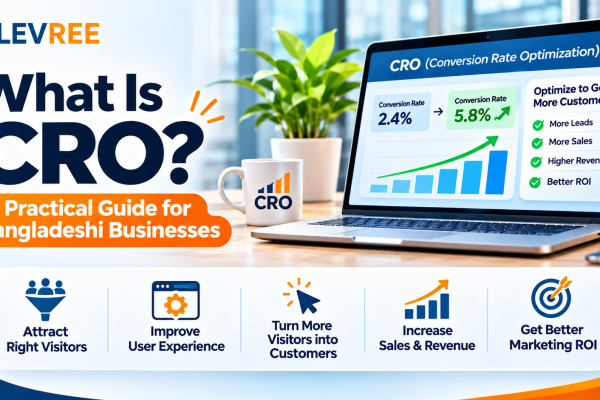
Conversion rate optimization is the process of testing and improving your pages, flows, and messaging so more of your existing traffic takes the action you want, whether that's filling out a form, making a purchase, or booking a call. No extra ad spend required.
This isn't guesswork or gut-feel redesigns. Done right, it's a repeatable system built on data. At Levree, auditing conversion behavior before touching a single pixel is how we approach every client site, because building on a broken foundation just moves the problem somewhere else. This article gives you the same framework: where to look, what to test, and how to measure what actually matters.
What your conversion rate is actually telling you
Before you can improve your conversion rate, you need to know whether it's actually a problem. Many businesses lack a clear benchmark, which means they either panic over a number that's perfectly normal for their industry or ignore a rate that's quietly costing them thousands every month.
Based on 2026 benchmark data, conversion rates vary significantly by industry. Financial services average 5.01%, healthcare sits at 3.60%, and e-commerce lands around 2.86%. Real estate drops below 1%. The goal isn't to chase an industry average, it's to understand your gap and decide whether you're underperforming relative to peers. A fashion brand converting at 1.72% is in line with benchmarks. The same rate on a B2B SaaS free trial is a serious problem. 2026 conversion rate benchmarks provide a useful starting point for comparison.
Channel is just as important as industry when reading your numbers. Paid search converts higher than social in most lead-gen categories. Email typically outperforms both, often reaching between 4.2% and 5.3% in e-commerce contexts. If you're only looking at a single site-wide average, you could have a paid social campaign bleeding money while your email list quietly carries the whole program. Segment your data by source before drawing any conclusions.
To set a reliable baseline, open GA4 and define your conversion event clearly. Segment by device type and traffic source, and pull data across a time window long enough to account for seasonal variation. Four to eight weeks is usually the minimum for most sites, the wider window controls for day-of-week swings and short-term traffic spikes that can skew your numbers. A baseline you trust is the difference between measuring real progress and chasing statistical noise.
Running a CRO audit to find where traffic leaks out
Most website CRO programs fail not because the tactics are wrong, but because teams jump straight to tactics without identifying the actual problem first. An audit is how you find the real leak points: the funnel steps, page sections, and UX failures that are costing you conversions right now. A structured CRO audit will help you prioritize fixes by impact and volume rather than opinion.
Start in GA4 and pull conversion rates by device, traffic source, landing page, and geography. Look for pages with high traffic but weak conversion rates, and identify exactly where in the funnel users are dropping off. A funnel step with 60% abandonment is more valuable to fix than a page with a 2% exit rate on low traffic. Volume matters as much as severity.
UX and messaging audit
Review your UX, content, and messaging. Do your headlines communicate a clear value proposition quickly, ideally within the first few seconds of the user arriving on the page? Are your CTAs visible on the initial viewport for common device classes and specific in their copy? Are your forms asking for more information than the value exchange justifies? This layer of the audit is about checking whether the page actually answers the intent of the user who arrived there.
Technical audit
Technical performance is often the most overlooked conversion killer. Run speed tests on your highest-traffic pages, especially on mobile. In a widely cited Portent study, conversion potential dropped from nearly 40% at a 1-second load time to 18% at 6 seconds. That's not a marginal difference. Check for broken elements, JavaScript conflicts, and form failures on mobile devices, because your analytics will rarely flag these automatically.
The highest-impact tactics for lifting conversion rate
Once the audit surfaces your priority problems, you match the fix to the finding. Not every tactic belongs on every site, these are the interventions with the strongest evidence behind them, and where to start depends entirely on what your audit revealed.
Landing page optimization: headlines and CTAs
On landing pages, the headline is the single highest-leverage element for most sites. Research consistently shows that a headline clearly stating what you offer and why it matters tends to outperform clever or brand-focused copy. Test benefit-led headlines against feature-led ones. Make your primary CTA prominent on the initial viewport, specific in its copy ("Get your free audit" beats "Submit"), and unambiguous about what happens next. These are low-cost changes to test and case studies regularly show double-digit lift when they address a genuine messaging gap.
Form friction is another high-return area. Shorter forms generally convert better, but the real principle is removing unnecessary friction rather than simply cutting fields. For forms with six or more fields, multi-step flows with clear progress indicators consistently outperform long single-page forms. One well-documented case study from Venture Harbour reported a 743% conversion lift from a multi-step approach applied to a complex lead-capture form, notably a high-involvement product with a longer decision cycle. For forms with five or fewer fields, a clean single-page layout usually wins.
Trust signals work as conversion amplifiers layered onto a page that's already clear. Reviews, client logos, security badges, and specific testimonials reduce hesitation at the decision moment. Add urgency where it's genuine, such as limited-time offers or low-stock messaging, but don't fabricate it. Users notice, and the trust you lose far outweighs any short-term lift.
A/B testing for CRO: how to get results you can trust
Running A/B tests without enough data is one of the most common and expensive mistakes in conversion rate optimization for websites. It creates false confidence and leads to decisions built on statistical noise rather than real user behavior.
The standard threshold for a valid test is 95% confidence with 80% statistical power. In practice, that means roughly 300 conversions and around 10,000 visitors per variation before you can read results with any reliability. For most small-to-medium sites, that's a meaningful constraint. If your site has under 10,000 monthly visitors, focus your tests on big changes with large expected lifts, and plan to run each test for at least two weeks to account for day-of-week variation in traffic and intent. For more on calculating required traffic and conversion targets, see this guide to sample size calculation for A/B tests .
Building a strong test backlog matters as much as running the tests correctly. Prioritize by three factors: how much traffic the page gets, how severe the current drop-off is, and how strong your evidence is from the audit. A form simplification backed by session replay data showing 70% abandonment is a far better first test than a button color change on a low-traffic page.
Every test should start with a clear hypothesis. Keep it structured and falsifiable, for example:
"If we simplify the mobile checkout form, completion rate will increase because session recordings show users dropping off at the payment step."
That format forces you to define what you're changing, what outcome you expect, and why, which makes post-test analysis far more useful.
Choosing the right conversion optimization tools for your stage and budget
Your tool stack should match what you're trying to do. There's no point paying for an enterprise testing platform before you've completed a single audit. Start with diagnosis, then move to experimentation.
For most small businesses starting out, two free tools cover the diagnostic phase entirely:
- Google Analytics 4 handles quantitative analysis: funnel drop-offs, conversion tracking, segment comparisons, and source-level performance.
- Microsoft Clarity adds behavioral context at no cost, with heatmaps and session replays that show exactly where users hesitate, scroll past, or rage-click on your pages.
Once you're ready to run structured tests and go deeper on qualitative research, mid-market options are worth the investment. Hotjar adds surveys, form analytics, and a more polished interface to the behavioral layer, starting around $32 per month. VWO is a strong all-in-one platform for teams running proper A/B tests, combining experimentation, heatmaps, and session replay from around $314 per month. For enterprise teams with complex personalization needs, Optimizely and Contentsquare handle that layer, both on custom pricing. For a practical overview of available platforms and how they fit different stages, check this CRO tools comparison .
The practical decision rule: start with GA4 and Clarity at zero cost. Move to Hotjar when you need qualitative feedback and on-page surveys. Graduate to VWO once your test volume and traffic justify a dedicated experimentation platform, typically when you're running three or more concurrent tests or need tighter statistical controls.
Measuring CRO progress and knowing when to bring in expertise
Conversion rate alone isn't a complete success metric. A tactic that lifts conversions but attracts low-quality leads isn't a win. Track revenue per visitor and cost per lead alongside raw conversion rate, and measure downstream impact after each test or site change.
After every test, document four things: the conversion rate change, the statistical significance, the impact on downstream metrics like lead quality or average order value, and revenue per session. This documentation builds a knowledge base where each test informs the next one. Over time, that compounding effect is where the real value lives.
Sometimes the audit reveals problems too deep for individual tests to solve: poor information architecture, a checkout flow built on outdated logic, or a site that was never designed with conversion in mind. At that point, patching individual elements is the slow path. The more efficient move is a full rebuild with conversion optimization built in from the start. This is how Levree approaches web projects, audit conversion behavior first, identify the systemic problems, then redesign around what the data shows, so clients aren't spending months iterating on a foundation that was never built to convert.
Start with the audit, not the tactics
CRO for websites is straightforward in principle: know your benchmark, run the audit, fix the highest-impact problems first, test with proper rigor, and measure what actually matters. Conversion rate optimization isn't a one-time project. It's an ongoing system that compounds over time as each test informs the next.
The businesses that win on conversion don't treat it as a campaign. They treat it as a continuous discipline. Start with two or three high-confidence changes backed by audit data, build from there, and measure everything. The traffic you're already paying for is more valuable than you're currently capturing, and optimizing website conversions from existing traffic is almost always faster than buying more of it.
If you want an audit that identifies exactly where your site is leaking conversions and what to fix first, Levree builds this into every engagement. Reach out and we'll show you what the data reveals.


Leave a comment
Your email address will not be published. Required fields are marked *