


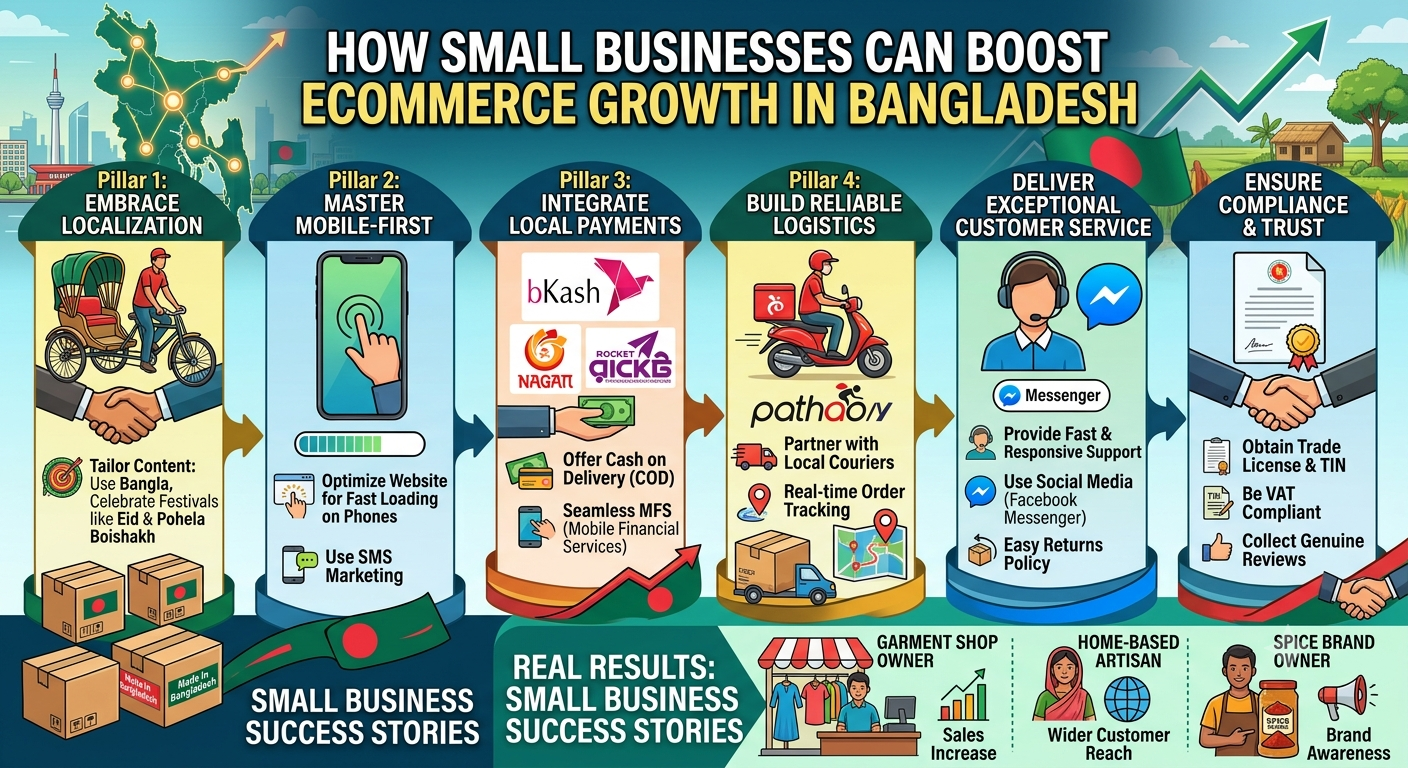
Learn how small businesses can grow their ecommerce business with practical strategies for choosing the right sales channels, optimizing marketplaces, improving mobile shopping experiences, running Google and Meta Ads, strengthening SEO, using social commerce, and following a proven 90-day growth plan to increase sales while lowering customer acquisition costs.
's e-commerce market hit $65, 66 billion in 2025 (per Bain estimates) and is growing at more than 20% annually, a massive opportunity most small sellers are still fumbling through. Most small business owners are guessing their way through channel selection, spreading thin across every platform, and watching their customer acquisition cost climb quarter after quarter. The gap between sellers who scale and those who stall usually isn't budget. It's strategy.
Bangladesh This guide answers how small businesses can boost ecommerce growth in India with a clear channel framework, a prioritized set of growth tactics, and a 90-day action plan to increase online sales without burning the next six months figuring it out. Brands that treat ecommerce growth as an integrated system, not a series of disconnected experiments, consistently outperform those who react to trends. That's the mindset this article is built around.
Choosing the right sales channels before you spend a rupee
The biggest strategic mistake small sellers make is choosing channels based on personal preference instead of category fit. The channel decision should be driven by three things: your product category, your average order value (AOV), and your stage of business. Every channel has a structural advantage, and understanding it will save you months of wasted ad spend.
Marketplaces give you immediate traffic but thin margins and limited direct customer data compared with owned channels. An owned website gives you margin control and long-term customer relationships, but you're responsible for generating every click. Social commerce sits in between: discovery is built in, but the buying journey is more fragmented. None of these is universally better. The right answer is category-specific.
Fashion and beauty sellers benefit from the built-in discovery on Flipkart and Meesho, where value-first Tier-2 and Tier-3 buyers are actively browsing. Meesho's GMV now exceeds $5 billion, built almost entirely on unbranded, low-ticket SKUs reaching buyers in smaller cities. If that's your customer, Meesho is your starting point. For higher-AOV electronics or niche D2C products, an owned storefront backed by Google and Meta ads often builds better unit economics over time.
Why your product category changes the entire channel equation
Fashion saw a 400% spike in ecommerce growth in recent years, driven by Meesho and Flipkart discovery. Beauty grew 75% with vertical platforms like Nykaa carrying much of that volume. Electronics buyers prefer credit card and EMI options, which shifts your platform and payment strategy significantly, Flipkart holds a 63, 64% category share in electronics. Grocery and essentials are increasingly dominated by quick-commerce models that are challenging for independent small sellers to access at scale.
The practical takeaway: before you choose a channel, map your category to where buyers already go. Trying to build Meesho-style volume on an owned site for ₹200 fashion SKUs, or listing premium electronics on a value marketplace, creates structural friction you can't advertise your way out of.
How small businesses can boost ecommerce growth in India: mobile-first design
More than 85% of online shopping in India happens on smartphones. If your storefront doesn't load in under three seconds, doesn't handle UPI checkout cleanly, and wasn't designed for a thumb, you're leaking conversions before a single ad rupee goes to work. Mobile conversion rates for fashion on well-optimized Indian storefronts run around 2% to 2.5%; for beauty, they can reach 3% to 4%. A poorly built mobile experience can cut those numbers in half.
The core elements of a conversion-ready mobile storefront are straightforward: sub-3-second load times, thumb-friendly navigation, product images optimized for small screens, and a checkout flow with as few steps as possible. Page speed also directly affects your Google search ranking, per Google's Core Web Vitals guidance, making it a double investment. Fix it once and it works for every visitor, organic or paid.
Reducing COD dependency through smarter UX and payment trust
COD still accounts for 30, 42% of Indian ecommerce transactions, and it's expensive to operate. Higher return rates, logistics friction, and delayed cash flow all eat into your margins. The goal isn't to eliminate COD entirely but to shift your payment mix toward UPI where your category allows it. In Tier-1 cities, UPI is already the preferred method for roughly 60% of shoppers.
The way to move your mix isn't to remove COD as an option but to make UPI more attractive. Add trust signals like ratings, transparent return policies, and secure payment badges. Offer a small incentive for prepaid orders. Be explicit about delivery timelines. These UX decisions add up over time and reduce your effective per-order cost without sacrificing conversion volume.
Marketplace optimization that actually moves product
Every major marketplace has its own ranking algorithm, but the core inputs are consistent: title keyword relevance, image quality, review velocity, price competitiveness, and fulfillment reliability. The differences that matter for SMBs are platform-specific. Flipkart dominates electronics and has a strong Tier-1 buyer base. Amazon rewards brand-registered sellers with A+ content that meaningfully improves conversion. Meesho is the right platform for unbranded, value-focused SKUs targeting Tier-2 and Tier-3 buyers, a rapidly growing segment.
Listing optimization is not a one-time task. Sellers who update titles, A/B test their main product image, and respond to Q&A on a weekly basis consistently outrank those who list and move on. Treat your marketplace listings as living performance assets, not static entries.
Sponsored ads on marketplaces: what ACoS to target
Amazon PPC ACoS for SMBs typically runs between 15% and 40%, with the average landing around 30%. The right strategy is to use sponsored listings as a launch accelerator: buy visibility early to build review count and organic rank, then pull back spend as organic position improves. Marketplace ads are not a permanent cost center. They're a mechanism for compressing the time it takes to earn organic placement.
Structure your campaigns by match type. Start with automatic campaigns to identify converting search terms, then build manual campaigns around your top performers. The goal is to use paid placement as a training dataset, not a crutch.
Social commerce and content-led growth for small sellers
Social commerce in India is growing at an estimated 55, 60% CAGR, and for SMBs it's one of the most accessible channels because the entry cost is low. Instagram Shopping enables product discovery and in-app purchase flows, reducing friction between browsing and buying. WhatsApp Commerce works especially well for repeat purchases and high-consideration categories where personal interaction builds trust. YouTube product content drives discovery in beauty, fitness, and home categories where demonstration matters.
The mistake most sellers make is spreading across all three at once. Build one channel well first. A focused Instagram strategy, consistent posting cadence, shoppable content, and active response to comments and DMs, will outperform a scattered presence across every social platform every time.
Micro-influencers vs broad paid social: where the ROI actually is
For small businesses working out how to boost ecommerce growth in India, micro-influencers with 10,000 to 100,000 followers in a specific niche often outperform broad paid social in cost per acquisition, particularly in niche or community-driven categories. Their sponsored content doesn't look like ads, their audience trusts them, and their fees are a fraction of macro-influencer rates. In many campaigns, the CPA gap is material, not marginal.
Pair micro-influencer seeding with a Meta retargeting campaign and the funnel gets significantly more efficient. A viewer sees the product through a trusted voice, visits your site or storefront, gets retargeted with a specific offer, and converts. That sequence works. Broad interest targeting without a warm audience in the middle usually doesn't.
Paid advertising and SEO as long-term CAC reducers
Bain's How India Shops Online 2025 benchmarks put blended CAC for ecommerce brands running Meta and Google ads in India at roughly ₹800, ₹1,200 per new customer. Meta CAC for D2C clothing sits around ₹45, ₹95 per acquisition when creative is strong; Google paid search CAC is typically lower when intent targeting is tight. These numbers are achievable, but creative quality is the variable most sellers underestimate.
A brand testing three ad variations will consistently pay more per acquisition than one testing ten. Creative testing is not a nice-to-have. It's the primary lever in paid social performance. Treating creative development and A/B testing as a core function of paid media management, not a secondary consideration, is what separates brands that hit efficient CAC from those that don't.
Why SEO is the cheapest customer acquisition channel most sellers are ignoring
Organic search has near-zero marginal CAC once content is indexed and ranking. A focused SEO strategy targeting product category pages and long-tail buying-intent queries builds traffic that grows over time. Paid ads stop the moment the budget does. SEO doesn't. For Indian SMBs operating with tight margins, this distinction matters enormously to unit economics over a 12, 24 month horizon.
The practical priorities are: category page SEO with keyword-optimized titles and structured data, Google Shopping feed optimization, blog content targeting specific buyer-intent queries, and local SEO for businesses with physical retail touchpoints. None of this is technically complex, but it requires consistency and patience that most sellers don't apply because results aren't immediate.
A 90-day plan: how small businesses can boost ecommerce growth in India
Days 1 to 30: fix what's bleeding before you scale
Start with the foundation: audit your mobile site speed and checkout flow, activate UPI-first payment options with a prepaid incentive, and ensure every marketplace listing has an optimized title and at least five high-quality images. Set up Google Analytics 4 with ecommerce tracking so you're measuring what's actually happening. These aren't exciting steps. They are the ones that determine whether your ad spend converts or leaks.
Quick wins for the first 30 days: if you're not already live on Meesho and your products fit a value-category positioning, activate it. Respond to every product review for 30 consecutive days to build review velocity. Launch one micro-influencer partnership in your category with a tracked link. These three actions cost very little and create measurable lift in both visibility and social proof.
Days 31 to 90: build the growth engine
This phase is where logistics strategy intersects with marketing. Set up a courier aggregator like Shiprocket if you haven't already. Urban local deliveries through aggregators run roughly ₹36, ₹45 per order; national deliveries land around ₹75 per 500g. Last-mile delivery challenges in India mean last-mile costs can represent up to 53% of total shipping cost, so tightening fulfillment directly improves your effective margin on every sale.
Launch a structured paid campaign on one channel with at least five creative variations. Begin building one content asset per week targeting a buying-intent keyword. Track blended CAC weekly and make budget allocation decisions based on data. By day 90, you'll have a clear picture of your best-performing channel, a lower CAC than day one, and a repeatable system you can scale with confidence.
Build the system, then scale it
Understanding how small businesses can boost ecommerce growth in India comes down to one core principle: build a clear system, then scale it, not a scatter-shot approach to every platform at once. The sellers gaining ground are choosing their channels deliberately, optimizing for mobile from day one, running marketplace listings as performance assets, and treating paid ads and SEO as complementary levers rather than competing choices. For broader market context, see the India e-commerce market report . The 90-day plan in this guide is a starting point. Execute the foundation in the first 30 days, build the growth engine in the next 60, and you'll have a model built to scale.
If you want a full-stack digital partner to build and run this system for your brand, Levree works with ecommerce businesses to integrate branding, web performance, SEO, paid media, and AI-powered content into a single growth engine. The goal is the same as this guide: more sales, lower CAC, and a business that grows over time rather than one that resets every time the ad budget pauses.

Leave a comment
Your email address will not be published. Required fields are marked *