


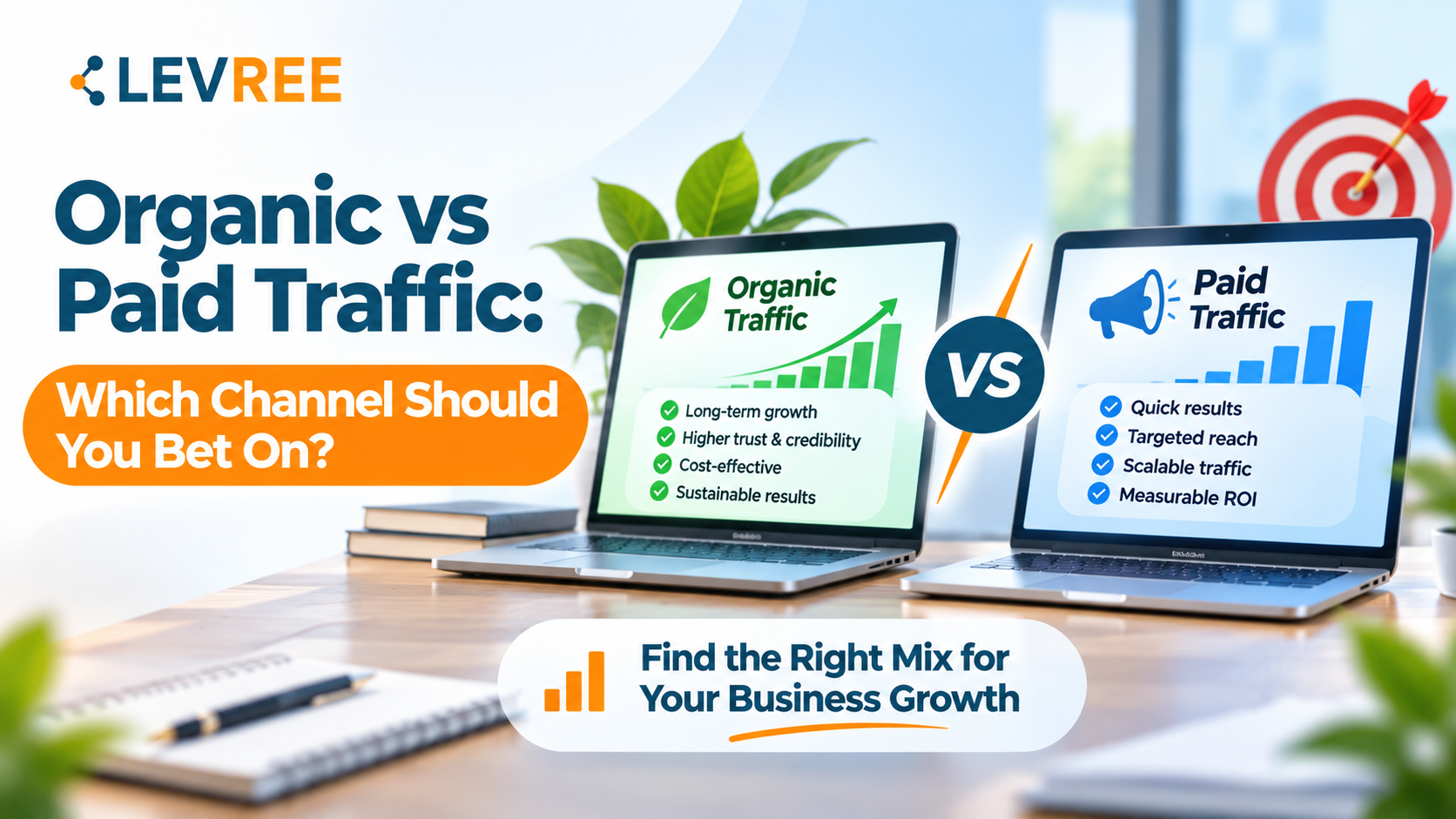
Organic vs paid traffic: Compare SEO and paid advertising by cost, ROI, conversion rates and long-term growth to choose the right marketing strategy for your business.
The debate between organic vs paid traffic is one every business owner eventually faces, and getting it wrong can cost you months of wasted budget or missed revenue. You've launched your business, built a website, and now you're fielding two pieces of advice simultaneously: run ads, and invest in SEO. Both sound right. Both cost money. And nobody is telling you which one actually fits your situation right now.
At Levree, we sit across from business owners regularly who are asking this exact question. The honest answer is: it's not one or the other. But getting the mix wrong means either burning spend on ads that stop the moment you pause them, or waiting 12 months for results you needed last quarter. This article gives you a practical framework to decide, allocate, and measure both channels based on where your business actually is.
What organic and paid traffic actually mean for your business
How organic search builds momentum over time
Organic traffic comes from earning visibility through SEO: publishing useful content, optimizing your website's technical foundation, and building enough authority that Google ranks you without any ad spend. The key word is "earning." It takes time, but once you rank, every click costs you nothing per visit. A Dhaka-based clinic appearing on page one for "best physiotherapist near Gulshan" or a service business showing up on Google Maps for a high-intent local query generates leads consistently, day after day, without daily ad spend driving it.
How paid traffic buys you immediate visibility
Paid traffic through Google Ads, Facebook Ads, or YouTube is bought visibility. You set a budget, define an audience, and your business appears in front of the right people immediately. The trade-off is direct: the moment you stop paying, the traffic stops. Think of a new e-commerce brand in Bangladesh launching a Facebook Ads campaign to its product page, sales can start flowing within days of launch, which is exactly what makes paid advertising attractive for time-sensitive goals. The spend clock starts on day one and doesn't pause. Paid is the right tool when speed matters most: a product launch, a seasonal sale, or testing a new market before committing to a long-form organic content strategy.
Organic vs paid traffic: the real cost and timeline trade-off
What organic SEO costs and when you'll see it
SEO is not free. It costs time, content production, technical setup, and usually an agency or specialist to execute properly. In Bangladesh, a local business SEO retainer typically runs BDT 20,000 to 25,000 per month at a credible agency, based on observed market rates across local providers. What that investment builds, though, is traffic with no per-click fee. The timeline is honest: expect initial measurable results in 3 to 6 months, meaningful ROI in 6 to 12 months, and the strongest compounding gains often arriving in year two (how long before you see SEO results). For a Bangladeshi SME with a 12-month horizon and tight cash flow, SEO builds an asset that keeps generating value long after the initial investment ends.
What paid advertising costs and when it pays back
With paid ads, you're buying results now. A Google Ads or Facebook campaign can go live within days and generate measurable conversions almost immediately. Global 2026 benchmark CPCs vary significantly by industry: healthcare sits around $2.80 to $5.50, ecommerce closer to $0.90 to $1.20, and professional services between $3.30 and $5.50. Bangladesh CPCs typically run 30, 50% below these global benchmarks, though country-specific data varies and these should be treated as directional estimates rather than fixed figures. In the paid vs organic traffic decision, speed of deployment is paid's clearest structural advantage, but so is the ongoing cost obligation.
ROI and conversion rates: what the numbers actually show
How conversion rates differ by channel and business type
For ecommerce, paid search converts at roughly 2.6% compared to organic's 1.9%, so paid edges ahead for online retail (paid search drives more conversions than organic search). For B2B and professional services, the relationship flips: organic search converts at approximately 2.1% while paid search drops to 1.0%. On click-through rates, the top organic result on Google earns a 27.6% CTR, while the average Google Ads CTR across industries sits at 6.42% (organic vs paid search statistics). If you're running an online shop, paid ads produce higher immediate conversion rates. If you're a consultant, a medical professional, or a service firm, organic authority typically converts better because trust is the deciding factor in the buyer's decision.
Why "better ROI" depends entirely on your time horizon
Paid ROI is fast and visible. Organic ROI is slower but compounds over time. Consider a straightforward scenario: a BDT 50,000 per month paid campaign generates leads this month but stops the moment the budget stops. The same BDT 50,000 invested in SEO over six months may produce traffic that continues generating leads for years. Neither choice is inherently wrong. The right answer is determined by your cash flow reality and how long you can afford to wait before results arrive, which is why earned media vs paid media isn't a debate so much as a sequencing question.
Choosing the right channel for your business stage and goal
How your company stage should guide the split
Budget allocation should shift as your business grows, not stay fixed. Here's a practical stage-based framework:
- Startups: 70 to 80% organic, 20 to 30% paid. Build the organic foundation first; use paid selectively for launches or key moments when immediate visibility matters.
- Growth-stage businesses: 55 to 65% organic, 35 to 45% paid. As assets and channels mature, balance both as the organic base begins producing consistent returns.
- Established businesses: Near 50/50, using paid for scale and speed while organic protects long-term visibility and brand trust.
If you're an early-stage Bangladeshi business where cash is tight, building a long-term organic asset will typically outperform short-term ad spend that disappears the moment it stops. Start with the organic foundation, then layer in paid at the points where speed becomes a competitive necessity.
Matching your channel to your campaign objective
The stage framework gets refined further when you map it against what you're actually trying to achieve. For awareness campaigns, lean 60 to 80% toward organic, content and SEO build trust and reach over time, which is exactly what awareness requires. For acquisition, shift 50 to 70% toward paid: it's the fastest lever for driving conversions at scale when you need volume quickly. Retention is the exception, both channels earn roughly equal weight here, since organic content sustains engagement while paid remarketing reactivates buyers who already know you. Each channel has a natural home in the funnel, and forcing the wrong one into the wrong role wastes money.
Why blending both channels outperforms either alone
What the research shows about combined channel performance
The evidence for blending isn't just strategic intuition. A peer-reviewed study by Ghose and Yang published in Management Science found that when paid and organic listings appeared together on the same search results page, total click-through rates, conversion rates, and revenues were significantly higher than when either appeared alone. The two channels reinforce each other in concrete ways: paid advertising builds brand familiarity that makes organic clicks more likely when users encounter your site again. Organic presence and content can improve paid campaign efficiency in practice, higher CTR, stronger landing-page relevance, which research shows leads to performance complementarity and lower effective campaign costs over time. Running both isn't just a budget decision. It's a compounding growth system where each channel strengthens the other.
A practical blended strategy that actually works
A blended approach works like this: use paid ads to generate immediate leads and cash flow while SEO builds authority in the background. Use the performance data from paid campaigns, which keywords convert and which audiences actually respond, to inform your organic content strategy. This eliminates guesswork from SEO and makes your content investment far more targeted. This integrated, full-stack approach is exactly what Levree builds for clients: combining SEO, paid campaign management, and data analytics under one strategy so neither channel operates in isolation and every dollar spent in one channel strengthens the other.
How to measure what's actually working
Why your reporting model changes the results you see
Most businesses run on last-click attribution by default, which assigns 100% of the conversion credit to the final touchpoint before purchase. This consistently makes paid ads look more valuable than they are and SEO look less valuable than it actually is, paid is often the last click while organic content influenced the customer weeks or months earlier (last-click vs multi-touch attribution). Multi-touch and data-driven attribution models spread credit across the full customer journey, and they typically reveal that organic channels contribute far more to conversions than last-click reporting ever shows. Before cutting a channel based on weak numbers, verify the model generating them, last-click attribution has buried more than a few high-performing SEO programs.
Simple steps to set up honest tracking
Three practical steps will give you a clearer picture of what's actually driving results. First, set up Google Analytics 4 with conversion goals tracking both organic and paid sessions separately. Second, apply UTM parameters to all paid campaigns so you can isolate paid traffic performance without it blending into your overall numbers. Third, compare channel-assisted conversions, not just last-click conversions, to understand how organic and paid work together across the full customer journey. For businesses working with Levree, these reporting structures are part of a standard performance dashboard from day one, so you always know which channel is carrying which part of the funnel and exactly where budget allocation changes will have the most impact.
Organic vs paid traffic: the answer is a strategy, not a choice
There is no universal winner in the organic vs paid traffic debate. The right channel depends on your business stage, campaign objective, time horizon, and budget reality. For most businesses, the smartest move is to start building organic assets now while using paid acquisition to generate immediate results, and to measure both with attribution models that show the complete picture rather than just the last click.
Before you allocate next month's budget, ask yourself one question: do I need results in the next 30 days, or in the next 12 months? If the answer is 30 days, paid search and paid social should carry the load while organic builds quietly in the background. If the answer is 12 months, the organic foundation needs to start now, because the businesses that dominate search a year from now are the ones investing in SEO today. When deciding between organic vs paid traffic, the sequence matters as much as the split.
Leave a comment
Your email address will not be published. Required fields are marked *